Consensus Adds De Gruyter Brill Full Text to Broaden Research Discovery
Licensed journal text expands the platform's reach in humanities and social sciences, while paywalls, coverage gaps, and source verification still define the limits of an AI research answer.
By WhatAI Editorial Team ·
Consensus is expanding the material its research agent can actually read, not only the abstracts it can index. On August 5, 2026, the company announced a full-text partnership with De Gruyter Brill, adding licensed journal content with particular relevance to humanities and social-science research. The agreement is the latest in a series of publisher relationships that also includes Wiley, Taylor & Francis, Sage, the American Chemical Society, the American Psychological Association, and the American Association for the Advancement of Science.
That change matters because a research assistant that can inspect methods, results, discussion, and supporting context has more evidence to work with than one limited to titles and abstracts. It also gives Consensus a better opportunity to serve fields where the argument may unfold across a long article and where a short abstract cannot represent the author's evidence, framing, or disagreement with prior scholarship.
The partnership should not be read as universal access or automatic accuracy. Consensus can use licensed text for search and analysis while a reader may still need a university login or personal subscription to open the original article. Full-text coverage varies by publisher and publication, and the announcement focuses on journals rather than promising comprehensive access to every book, monograph, archive, or historical source associated with De Gruyter Brill.
### Full text changes retrieval before it changes writing
The most important benefit of full-text access happens before a polished answer appears. Search systems have more material for matching a question to relevant work. A concept that is absent from a title or abstract may be discussed in detail inside a methods section, footnote, literature review, or conclusion. An intervention may look effective in the abstract while the paper's limitations narrow that conclusion to one population, measurement choice, or short follow-up period.
Consensus says its search combines semantic retrieval with keyword methods, then reranks candidate papers using relevance and quality signals. Pro answers can synthesize up to 20 papers. Deep Review uses multiple targeted searches, examines more than 1,000 candidates, and can select up to about 50 papers for a structured report. When full text is available, those stages can draw on more of each paper.
More available text does not guarantee better interpretation. A model can still connect the wrong passage to a claim, confuse an author's summary of another study with the author's own finding, miss a qualification, or mistake correlation for causation. Researchers should use the full-text indicator and source snippets as verification tools, then open the original paper and inspect the surrounding section. The right question is not simply whether an answer has citations. It is whether each citation supports the exact claim made, in the relevant population and context.
### Humanities research is not a tidy consensus problem
De Gruyter Brill is particularly strong in areas such as history, philosophy, theology, classics, linguistics, law, and social sciences. These disciplines can benefit from better discovery, but they also expose the limits of a product name built around consensus. Many humanities questions are not properly answered by counting papers as positive or negative. Scholars may disagree because they use different archives, interpret the same source through different frameworks, define a period differently, or ask different normative questions.
A useful AI workflow in these fields should map arguments rather than force them into a vote. It can identify schools of thought, trace how a concept changes over time, compare evidence bases, surface counterarguments, and build a reading list. It should distinguish a historian's interpretation from an empirical claim and preserve who is arguing what. A confident paragraph that blends incompatible frameworks is less useful than a table that identifies authors, periods, sources, claims, and contested assumptions.
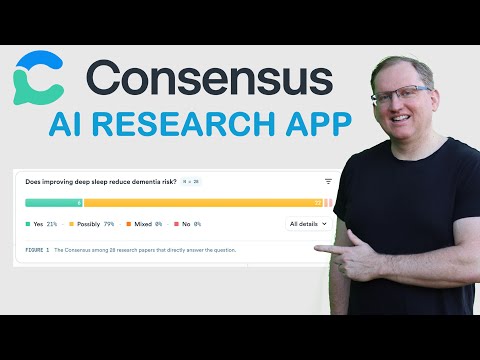
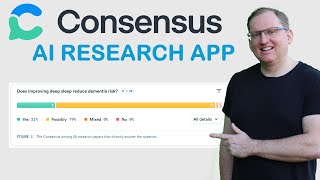
The Consensus Meter is especially easy to misuse here. The feature analyzes 5 to 20 highly relevant papers for eligible directional questions and classifies their findings as Yes, No, Possibly, or Mixed. Consensus itself warns that the sample is not the complete literature, that the model can misclassify a paper, and that question nuance can be lost. Those limitations apply in any field and become more pronounced when the scholarship is interpretive rather than experimental.
### Publisher access is not reader access
The practical distinction between analysis rights and reader rights deserves attention. Consensus says publisher full text can be used to improve retrieval and answer generation, and its partnership announcement says results direct users back to the original work. It also says the licensed content is not used to train AI models. Those are useful commitments, but they do not remove a publisher paywall.
A user may receive a summary influenced by an article that they cannot independently download. For casual orientation, that may still be valuable. For academic writing, peer review, clinical decisions, policy work, or any claim likely to be challenged, the inability to inspect the source is a material limitation. Researchers should mark inaccessible sources in the evidence table, use institutional access or interlibrary services where available, and avoid quoting or making decisive claims from material they cannot verify.
Coverage should also be recorded, not assumed. Consensus describes a database of more than 220 million papers drawing from Semantic Scholar, OpenAlex, its own crawl, publisher agreements, and open-access documents. The broader corpus can include preprints and conference proceedings. A large number is not the same as comprehensive indexing, and it does not ensure equal representation across languages, regions, disciplines, or older collections. Preprint exclusion, publisher filters, study-design filters, and exact search logs are essential when publication status affects the conclusion.
### Deep Review still needs a documented method
Deep Review and the Research Agent can reduce the mechanical burden of an early literature review. They can expand terminology, run several searches, screen a larger candidate pool, compare papers, produce a structured report, and export citations or evidence tables. The June 2026 update also brought Deep Search into My Library and collections, with custom outputs such as PICO or SPIDER tables, reading lists, and scoping maps.
Those capabilities are best treated as research infrastructure, not a completed method. A systematic review needs a protocol, appropriate database selection, reproducible searches, explicit inclusion and exclusion criteria, duplicate screening where required, critical appraisal, and a transparent account of missing and excluded evidence. Consensus can assist several of those steps, but a final report should not obscure which steps the user performed, which steps the agent performed, and where judgment changed the result.
A defensible workflow starts with Paper Search and a written question. The researcher records the exact query, date, filters, and result count, examines whether relevant terms and known papers appear, and revises the strategy. Only then should Pro or Deep generate a synthesis. The resulting table should include design, population, setting, intervention or exposure, comparator, outcome definition, follow-up, uncertainty, funding, and limitations. Blank cells are better than invented details.
The search should then be repeated in discipline-appropriate databases. Citation chasing, grey-literature searches, reference-list review, and expert consultation may still be necessary. Consensus is especially useful for finding vocabulary and candidate papers, but no academic search product should silently become the only source of recall for a high-stakes or publication-grade review.
### What researchers should verify before citing
First, check publication status. Do not label a preprint, conference item, or manuscript as peer reviewed without confirmation. Second, check whether Consensus analyzed full text or only an abstract and metadata. Third, verify that the cited passage supports the claim and that the paper studied the relevant population, exposure, comparator, and outcome. Fourth, inspect design quality and uncertainty rather than using citation count or journal reputation as a substitute for appraisal. Fifth, record inaccessible full-text sources and do not rely on quotations you cannot inspect.
The same discipline applies to uploaded and imported material. Consensus can accept up to 20 PDFs at a time, but scanned or image-only documents may fail. Zotero import is one way rather than continuous synchronization, and not every imported item type is currently included in My Library search. Researchers should confirm that the intended documents are present, searchable, current, and in the correct collection before asking cross-document questions.
Privacy also belongs in the method. Consensus says uploads are private unless shared through a collection and that user queries, content, and personal data are not used to train its own or third-party large language models. Its policy describes encryption and says it does not sell personal information. However, it uses cloud service providers and retains data for as long as reasonably necessary for stated purposes rather than promising one fixed period for every category. Unpublished manuscripts, confidential reports, participant data, patient information, and contract-restricted content still need an institutional data-handling decision before upload.
The De Gruyter Brill agreement is a meaningful expansion because it improves the chance that Consensus can retrieve and inspect the substance of scholarship outside the heavily represented biomedical and technical literature. It makes the platform more useful for discovery across humanities and social sciences. The responsible conclusion is narrower than the marketing headline: more licensed full text can improve search and evidence extraction, but it does not make coverage universal, remove paywalls, turn interpretation into consensus, or eliminate the obligation to read and evaluate the source.
Consensus searches more than 220 million scholarly papers and returns cited answers, paper lists, evidence tables, study snapshots, and structured research reports. Its strongest workflows combine question refinement, targeted filters, full-text analysis where available, and direct inspection of the cited sources.
How Consensus Searches and Synthesizes Research
Consensus combines semantic and keyword retrieval, quality-aware reranking, and AI analysis. Paper Search offers a browse-first result list, Pro summarizes as many as 20 papers, and Deep Review examines more than 1,000 candidates across multiple searches before selecting up to about 50 papers for a report. The Research Agent can plan steps, apply filters, inspect papers, and generate a cited response.
Who Should Use Consensus.app?
Consensus fits students, researchers, clinicians, analysts, journalists, and evidence-focused teams that need faster discovery and synthesis. It should support, not replace, formal database searches, systematic-review protocols, critical appraisal, statistical analysis, professional judgment, or reading the primary paper. Verify full-text status, publication type, methods, population, and quoted evidence before relying on an answer.
About Consensus.app
Consensus is an AI academic search and research synthesis platform built around a database of more than 220 million scholarly papers. It accepts natural-language questions, keywords, Boolean searches, titles, authors, DOIs, and subject terms, then combines semantic retrieval with keyword matching and relevance reranking. Users can browse papers directly, generate cited answers with Pro, commission structured Deep Reviews, or let the Research Agent plan and execute a multi-step evidence search. The product includes study snapshots, full-text chat when content is available, evidence tables, filters for study design and publisher, a Consensus Meter for directional questions, Medical Mode, citation graphs, personal and shared collections, PDF uploads, Zotero import, and citation exports. Full-text coverage comes from open-access documents, uploaded files, and publisher agreements including Wiley, Taylor & Francis, Sage, ACS, APA, AAAS, and De Gruyter Brill. A paper can still be paywalled for the reader even when licensed text is available to the product for analysis. Consensus is useful for discovery, question refinement, scoping reviews, evidence maps, reading lists, and fast orientation. It is not a replacement for a reproducible systematic-review method, domain expertise, database-specific searches, critical appraisal, or checking the cited paper. The database also contains preprints and conference material, full text is not universal, AI classifications can be wrong, and the Consensus Meter summarizes only a limited result set.
Use Cases
Key Features
- ✓ Academic search across more than 220 million papers
- ✓ Natural-language, keyword, Boolean, author, title, DOI, and subject-term queries
- ✓ Hybrid semantic and keyword retrieval with quality-aware reranking
- ✓ Paper Search for deterministic browsing without an AI answer
- ✓ Pro answers synthesized from up to 20 relevant papers
- ✓ Deep Reviews that examine more than 1,000 candidates and synthesize up to about 50 papers
- ✓ Research Agent for planning and running multi-step evidence searches
- ✓ Follow-up Threads that retain question and source context
- ✓ Study Snapshots covering design, population, methods, outcomes, and quality signals
- ✓ Consensus Meter for Yes, No, Possibly, or Mixed directional evidence
- ✓ Medical Mode focused on clinical literature and guidelines
- ✓ Full-text analysis when licensed, open-access, or user-uploaded text is available
- ✓ Exact source snippets and citations for supported full-text papers
- ✓ Filters for date, study design, sample size, population, citations, journal, publisher, and open access
- ✓ Preprint exclusion and human or animal study filters
- ✓ Table View for comparing papers and extracted evidence
- ✓ Citation Graph for exploring connected research clusters
- ✓ My Library, collections, shared collections, and bibliographies
- ✓ Upload and chat with as many as 20 PDFs at a time
- ✓ Zotero library import with folder preservation
- ✓ DOI, RIS, and BibTeX imports
- ✓ PDF, formatted-text, CSV, RIS, bibliography, and LaTeX exports
- ✓ Citation formatting for APA, MLA, Chicago, Harvard, LaTeX, and AMA
- ✓ ChatGPT app, Claude connector, MCP, and organization API options
- ✓ Incognito search mode and search-history controls
Pricing
Free
$0
- • Unlimited Paper Searches
- • Limited Pro messages each month
- • 3 Deep Reviews each month
- • 10 Study Snapshots each month
- • Core search, filters, citations, and library tools
Pro
$20/mo or $144/yr
- • Unlimited Paper Searches
- • Unlimited Pro messages
- • 15 Deep Reviews each month
- • Unlimited Study Snapshots
- • Annual price equals $12 per month
Deep
$65/mo or $540/yr
- • Everything in Pro
- • 200 Deep Reviews each month
- • Unlimited Study Snapshots
- • Annual price equals $45 per month
Teams
Custom
- • All Pro features
- • 50 Deep Reviews per user each month
- • Centralized billing and administration
- • Volume discounts for teams of up to 200 seats
- • Organization and integration options depend on quote
Enterprise
Custom
- • Designed for more than 200 users
- • University, institute, and large-organization deployment
- • Volume pricing and centralized administration
- • Early feature access and contractual options
- • Contact Consensus for scope and terms
Pricing varies by plan and region — see current pricing.
Plan features change — last updated: 2026-08-16.
Details
Tags
Consensus.app Community Discussions
Explore community discussions. Ask and answer questions on Consensus.app to grow and learn together.
Consensus.app Showcase
Consensus.app — Frequently Asked Questions
What is Consensus.app?
Consensus is an AI academic search and research synthesis platform. It searches more than 220 million papers, ranks relevant evidence, and can generate cited answers, study summaries, evidence tables, and structured reviews.
Is every paper in Consensus peer reviewed?
No. The broader database includes scholarly journal content but can also include preprints and conference proceedings. Use publication-type and preprint filters, then verify the status of each source before presenting it as peer reviewed.
How much does Consensus cost?
As verified on August 16, 2026, Free costs $0, Pro costs $20 monthly or $144 yearly, and Deep costs $65 monthly or $540 yearly. Teams and Enterprise use custom pricing.
What is included in the Free plan?
The Free plan includes unlimited Paper Searches, a limited monthly allocation of Pro messages, 3 Deep Reviews per month, and 10 Study Snapshots per month. Limits and feature names can change, so check the plan page before purchase.
What is the difference between Pro and Deep Review?
A Pro answer synthesizes a focused set of up to 20 relevant papers. Deep Review runs multiple targeted searches, examines more than 1,000 candidates, selects up to about 50 papers, and creates a more structured report with methods, results, discussion, and export options.
What does the Consensus Research Agent do?
The Research Agent plans and executes multi-step research tasks. It can refine a question, chain searches, apply filters, read across results, and produce a cited answer. Its plan and evidence still require user review.
How does the Consensus Meter work?
For eligible directional questions, the Meter classifies findings from 5 to 20 highly relevant papers as Yes, No, Possibly, or Mixed. It is a limited snapshot, not a vote across all research, and the model can misclassify a paper.
Does Consensus read full papers?
Sometimes. It can analyze full text from open-access sources, supported publisher agreements, and user-uploaded PDFs. When full text is unavailable, it may rely on an abstract and metadata. Look for the full-text indicator and inspect the cited passage.
Does licensed full text remove a publisher paywall?
No. Consensus may be permitted to search and analyze licensed text while the user still needs a personal or institutional subscription to open or download the article from the publisher.
What is Medical Mode?
Medical Mode narrows search toward roughly 8 million papers and guidelines from selected clinical sources, including about 50,000 guidelines. It improves focus but does not provide medical advice or replace current guidelines and clinician judgment.
Can Consensus replace a systematic review?
No. It can accelerate discovery, screening, evidence mapping, and drafting, but a systematic review needs a registered or documented protocol, reproducible searches across appropriate databases, independent screening, critical appraisal, and transparent synthesis.
Can I upload private PDFs?
Yes. Users can upload as many as 20 PDFs at a time, with a 50 MB file limit, and ask cited questions across them. Scanned or image-only documents may not work. Uploaded documents are private unless placed in a shared collection.
Does Consensus sync automatically with Zotero?
No. Zotero import is one way and updates require another manual import. It can preserve folders, but current search and analysis support within My Library is centered on journal articles rather than every Zotero item type.
Does Consensus use my searches to train AI models?
The current privacy policy says queries, content, and personal data are not used to train Consensus or third-party large language models. This is a vendor policy commitment, and the policy does not promise a single fixed retention period for all data.
Are Consensus answers always accurate?
No. Citations make verification easier, but retrieval can miss evidence and AI can misread methods, flatten nuance, choose an unsuitable population, or classify a paper incorrectly. Check the source, passage, study design, and applicability.
Sources & References
- Consensus official website ↗
- Consensus official pricing ↗
- Consensus subscription plans ↗
- Student and clinician discounts ↗
- Consensus product FAQs ↗
- How Consensus search and ranking work ↗
- Consensus research database and full-text coverage ↗
- Consensus Meter methods and limitations ↗
- Upload and chat with documents ↗
- Importing a Zotero library ↗
- Exporting Consensus results ↗
- Chatting with full-text papers ↗
- Consensus product changelog ↗
- Consensus full-text search overview ↗
- Medical Mode announcement ↗
- De Gruyter Brill full-text partnership ↗
- Taylor and Francis full-text partnership ↗
- Consensus privacy policy ↗
- Consensus contact page ↗
Try Consensus.app
Visit the official website to get started with Consensus.app today.
Visit Consensus.app →