Similarweb Moves From Data to Decisions
Use estimates to compare, not pretend certainty
By WhatAI Editorial ·
Similarweb Is Becoming a Digital Intelligence Operating Layer
Similarweb is easy to misunderstand because most people first meet it through a free website traffic checker. Enter a domain, get an estimate, compare a competitor, and the product looks like a traffic analytics tool.
That description is now too narrow.
In 2026, Similarweb spans competitive web intelligence, SEO, advertising intelligence, AI search visibility, app intelligence, retail intelligence, sales intelligence, stock intelligence, APIs, data feeds, native integrations, MCP, specialized AI agents and AI Studio. The platform is increasingly trying to own the path from an external market signal to a business decision.
That expansion creates both the opportunity and the buying risk.
If a team needs one quick estimate for a competitor, Similarweb can be excessive. If the team repeatedly needs to understand markets, competitors, search demand, traffic channels, AI visibility, app behavior, ecommerce demand or account-level digital signals, the breadth starts to compound.
The strongest way to evaluate Similarweb is therefore not by asking whether it has the most dashboards. Ask whether external digital behavior is a recurring input to decisions your team already makes.
Competitive Intelligence, Not First-Party Analytics
The most important distinction on the entire page is this:
Similarweb is not a replacement for Google Analytics, Adobe Analytics or another direct measurement system on a website you own.
Direct analytics measures activity on your own property. Similarweb estimates activity across the wider digital market so that you can compare websites and companies you do not control.
That difference is the product.
Similarweb's methodology combines multiple digital signal sources, runs them through cleaning, synthesis, calibration and predictive modeling, and then produces standardized market estimates. The benefit is comparability. A company can view many competitors through one methodology instead of needing access to every competitor's internal analytics.
The trade-off is precision.
Similarweb explicitly describes itself as an estimation tool and says its numbers should not be expected to match direct measurement exactly. Its own accuracy documentation says the useful goal is trend alignment with first-party analytics. It also warns that small sites can have limited data or display N/A when there is not enough signal to support a reliable estimate.
That should change how teams use the numbers.
"Competitor A appears to be growing materially faster than Competitor B" is a sensible market-intelligence conclusion.
"Competitor A had exactly 287,431 visits last month" is usually the wrong way to present modeled traffic.
The more a decision depends on an exact number, the more it should be validated against first-party, financial, survey, CRM or other direct evidence.
The Platform Has Shifted From Data Retrieval to Data Interpretation
The most important 2026 change is AI Studio.
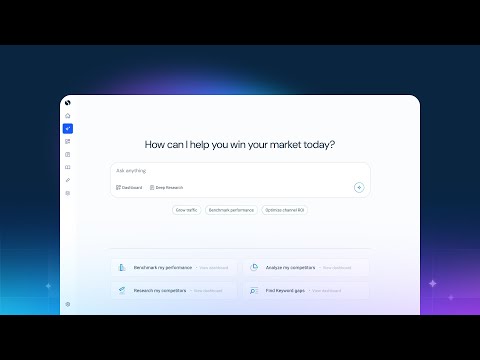
Similarweb launched AI Studio in February 2026 as a conversational layer across its digital intelligence. Instead of navigating multiple reports, users can ask business questions in natural language and receive answers built from Similarweb data.
The current product separates three jobs.
Chat is for fast exploratory questions.
Deep Research creates longer structured reports that synthesize multiple datasets.
AI Dashboards turn a plain-language request into a live visual intelligence view.
Similarweb's current help documentation gives those modes different credit costs in 4.0 packaging: 25 credits for Chat, 300 credits for Deep Research and 300 credits to create an AI Dashboard. That matters because "AI included" does not mean every form of analysis has the same operating cost.
AI Studio also has access to a much wider data layer than a normal chatbot browsing the open web. Similarweb says it can work across web traffic, keywords, apps, company data, retail data and custom Similarweb assets, subject to the account's entitlements and permissions.
The practical gain is speed.
A strategist can move from "Which competitor is gaining share?" to "Which channel explains the change?" to "Which keywords are associated with that growth?" without rebuilding a separate report at every step.
The risk is accepting a generated interpretation too quickly.
AI can shorten the distance from question to answer. It does not remove the need to check definitions, date ranges, geography, device scope, sample coverage and whether the underlying Similarweb estimate is strong enough for the decision.
AI Search Is Now a First-Class Similarweb Product
Similarweb's AI Search Intelligence is no longer a small feature attached to SEO.
Its self-service AEO Intelligence plan currently starts at $99 per month when billed annually or $129 month-to-month. It includes one user, three months of historical data, AI Brand Visibility, 150 tracked prompts, sentiment analysis, citation analysis and AI traffic.
The next self-service package combines AEO, SEO and competitive intelligence for $333 per month billed annually or $399 monthly. The broader version adding advertising intelligence is $542 annually billed per month or $649 month-to-month.
Those prices are important because Similarweb is now competing for more than the classic competitive-traffic budget. It is also competing for SEO, AEO, paid-media intelligence and market-research spend.
The AI Search Intelligence layer also changed materially during 2026.
Prompt management and core competitor tracking became more controllable. Historical AI answers and daily AI brand visibility made it easier to see how responses change. Trending Topics added a research layer for what people are asking AI about. The Recommendations Hub moved beyond simple citation counting toward recommended actions around topic visibility. And in August, Similarweb introduced AI Ads to track advertising appearing inside AI-driven surfaces such as ChatGPT and Google AI experiences.
The buying question is not simply whether AI search matters.
It is whether your team needs a dedicated measurement layer for it.
A small company with ten important prompts can manually inspect AI answers. A brand operating across many topics, products, competitors and markets eventually needs a structured system for tracking visibility, citations, sentiment and traffic over time.
That is the point where an AEO platform starts earning its place.
Web Intelligence Still Matters More Than the AI Labels
Despite the amount of AI in Similarweb's current positioning, the core data remains the reason to buy.
The current self-service Competitive Intelligence package costs $125 per month billed annually or $199 monthly. It is a single-user plan with three months of history and covers website performance, traffic and engagement, customer demographics, marketing-channel analysis and competitor alerts.
That package is useful when the recurring job is simple: understand who is winning digital attention, where traffic is coming from, how channel mix differs and whether the market is moving.
The higher $333 package adds the pieces an SEO or growth team is more likely to need: organic search, keyword research, rank tracking, site audit, backlinks and AEO intelligence.
The $542 annual-billing package adds advertising intelligence, including creative and campaign insights, search, display and social intelligence, advertiser demand signals and ad-spend views.
Every self-service package currently lists one user. Business and Enterprise packages are custom.
That makes Similarweb's commercial model unusually important to the decision. A solo analyst can see a public price. A team that needs multiple seats, longer history, API access, AI Studio, advanced integrations or broader enterprise controls moves into a custom sales process.
The price therefore needs to be evaluated against the number of decisions, reports and workflows the platform replaces, not against a cheap keyword tool.
Similarweb Is Also Becoming Data Infrastructure for AI
The MCP layer changes Similarweb's role again.
Similarweb now exposes digital intelligence through MCP so AI tools and agents can work with its datasets inside external workflows. The company lists support across environments including ChatGPT, Claude, Cursor, n8n and Zapier-oriented workflows.
That means Similarweb does not have to be the interface where analysis happens.
A team can ask an external agent to research a market, compare competitors, inspect keyword demand or analyze app activity while Similarweb supplies the structured digital signals.
The company has also expanded distribution through partnerships and integrations with systems such as Claude, Perplexity and Manus.
This is strategically important.
The value of proprietary data increases when the interface becomes interchangeable. If a user can ask the same business question inside Claude, ChatGPT, an internal agent or Similarweb AI Studio, the durable asset is not the chat window. It is the differentiated dataset, the permission model and the reliability of the retrieval path.
That is why Similarweb's move into MCP matters more than another chatbot feature.
Specialized Agents Move From Insight Toward Action
Similarweb's AI Agents are narrower than AI Studio.
The AI Trend Analyzer looks for demand spikes and helps explain what is driving them.
The AI SEO Strategist benchmarks a site against competitors, identifies gaps and creates a prioritized content plan.
The AI Meeting Prep agent creates sales briefings using digital signals.
The AI Outreach agent turns account-level signals into tailored sales messages.
The AI Prospecting Agent lets sales teams describe the companies they want and generates lists with company, contact and signal data.
This is a sensible agent design.
Instead of one general autonomous worker, Similarweb is attaching agents to specific datasets and decisions. The agent has a defined job, known inputs and a bounded output.
That makes performance easier to judge.
Did the Trend Analyzer identify a demand shift early enough to matter?
Did the SEO Strategist surface a real content gap?
Did the Meeting Prep agent reduce research time without introducing false claims?
Did Prospecting produce accounts the sales team actually wanted?
Those are operational questions, not AI-demo questions.
Sales, CRM and Data Integrations Broaden the Use Case
Similarweb is also increasingly useful outside a marketing analyst's browser tab.
Sales Intelligence integrates natively with Salesforce and HubSpot. Teams can export companies and contacts, suppress accounts already in the CRM, enrich existing records and trigger workflows around traffic, technology and intent signals.
Similarweb's broader data integration layer supports systems including AWS, Google Cloud, Tableau, Looker Studio, Power BI, Excel, Databricks and Snowflake for customers with the appropriate API access.
This is where enterprise value can compound.
A competitive-intelligence dashboard is useful when somebody remembers to open it.
A digital signal inside the CRM, BI dashboard or AI workflow can change what a team does automatically.
But integration also raises the standard for buying.
Before paying for an enterprise package, define exactly which datasets need to leave Similarweb, which systems consume them, what refresh frequency is required and which decisions improve when the data arrives. "We might use the API later" is not a strong reason to buy enterprise infrastructure.
The Accuracy Caveat Should Stay Visible
Similarweb's strongest editorial advantage is that its documentation is unusually direct about estimation.
Its accuracy page says the platform does not expect estimates to align exactly with direct measurement. It says larger sample sizes generally improve confidence, and small websites can produce more limited results.
Its "Not enough data" guidance explains that Similarweb may withhold numbers when volume is too low to meet its reliability threshold. Some desktop-only features can also go blank when a site does not have enough desktop traffic.
That is a feature, not a flaw, when compared with a system that confidently fabricates precision from weak data.
The mistake is treating a modeled estimate as an accounting figure.
A good Similarweb workflow compares multiple signals:
traffic direction,
share versus competitors,
channel mix,
keyword demand,
referral changes,
audience shifts,
AI visibility,
ad activity,
app behavior,
and first-party outcomes where available.
When several signals point in the same direction, confidence improves.
When one isolated estimate conflicts with everything else, investigate before acting.
Privacy and AI Need Precise Wording
Similarweb's June 2026 Privacy Policy says information collected from users through the Similarweb website is not used to power its analytics services. Its data methodology describes cleaning to remove personally identifiable information at the source, and Similarweb describes its panel-based behavioral datasets as aggregated and anonymized.
AI Studio inherits Similarweb's account permissions and data entitlements, which is important for enterprise use.
But WhatAI should not stretch those statements into claims that the public documentation does not make.
For example, Similarweb's Privacy Policy specifically says Google Workspace API data is not used to develop, improve or train generalized AI or machine-learning models. That is a precise statement about a specific data path. It is not the same thing as a universal promise about every prompt, conversation or AI feature in every Similarweb product.
AI Studio also includes persistent User Memory that can remember business context, preferences and competitive information across conversations.
For teams using confidential strategy, the correct step is therefore to review the current contract, privacy policy, AI terms, retention controls and enterprise configuration rather than relying on a broad marketing phrase.
Affiliate Opportunity: Active Program, Public Rate Is Not Clear Enough
Similarweb has an official PartnerStack-linked affiliate partnership.
That is enough for WhatAI to identify a genuine affiliate opportunity.
What is not clear enough from Similarweb's current public partner page is the exact universal commission rate, duration and cookie window.
Current third-party affiliate directories disagree. Some list a 50 percent revenue share for the first 12 months, while older directories still show different structures. That is precisely the kind of conflict WhatAI should not hide.
The safe treatment is to apply through Similarweb's official PartnerStack program, read the approved dashboard terms, and only then publish the live rate.
The JSON therefore leaves the public affiliate tracking link empty until WhatAI has an approved account.
Who Similarweb Is Best For
Similarweb is strongest for teams that repeatedly need external digital context.
That includes market researchers sizing categories and tracking leaders.
Growth and strategy teams benchmarking competitor acquisition.
SEO teams combining keyword research with market-level traffic data.
AEO teams measuring AI brand visibility, citations and prompt coverage.
Sales teams using digital signals to qualify and prioritize accounts.
Investors and analysts using alternative digital behavior as one input to research.
Agencies building competitive reports across many clients.
It is less compelling for a small company that mainly needs accurate analytics for its own website, a low-cost rank tracker, or an occasional one-off competitor check.
Google Analytics or another first-party tool should remain the source of truth for your own site.
Ahrefs or Semrush can be a better value when the job is primarily SEO.
A specialized AEO platform may be easier to justify if AI visibility is the only required job.
The Similarweb advantage appears when several of those research jobs need to share the same market context.
The WhatAI Decision
Similarweb does not earn its place because it can estimate a competitor's monthly visits.
It earns its place when those estimates become part of a repeatable decision system.
Use it to compare, benchmark, detect change and form hypotheses.
Use first-party data to verify the parts of the decision you can measure directly.
Use AI Studio to shorten analysis, not to remove scrutiny.
Use AI Search Intelligence when the scale of AI visibility is too large for manual checking.
Use MCP and APIs only when the data genuinely improves downstream work.
The central rule is simple:
Treat Similarweb as a comparative instrument, not an accounting ledger.
The value is not the traffic number. The value is seeing enough of the market to make a better decision than you could from your own analytics alone.
Similarweb estimates and compares digital activity across websites, apps, search, advertising and AI discovery. Its 2026 platform adds AI Studio, specialized agents, AI Search Intelligence, MCP and enterprise data integrations on top of its core competitive-intelligence datasets.
Similarweb Pricing and Plan Differences
Self-service pricing currently starts at $99 per month billed annually for AEO Intelligence and $125 for Competitive Intelligence. Broader SEO, AEO and advertising packages rise to $333 and $542 on annual billing, while Business and Enterprise pricing is custom.
Is Similarweb Accurate Enough to Use?
Similarweb is a modeled estimation platform, not direct first-party analytics. It is strongest for comparison, trend analysis and competitive context. Exact traffic figures, especially for smaller sites, should be treated as estimates and checked against direct evidence when a decision requires precision.
About Similarweb
Similarweb is an AI-powered digital intelligence platform for competitive research, website and app benchmarking, SEO, advertising analysis, AI-search visibility, sales intelligence and market analysis. It combines modeled digital-behavior data with AI Studio, specialized agents, APIs, data feeds, CRM integrations and MCP so teams can compare markets and competitors beyond the first-party analytics they control.
Use Cases
Key Features
- ✓ Website traffic and engagement benchmarking
- ✓ Competitive market and channel analysis
- ✓ Customer demographics and audience insights
- ✓ Competitor alerts and market monitoring
- ✓ Organic keyword research and SEO intelligence
- ✓ Rank tracking, site audit and backlink analytics
- ✓ AI Search Intelligence for brand visibility
- ✓ Prompt, citation and sentiment analysis
- ✓ AI traffic and generative search referral analysis
- ✓ Trending Topics for AI-search research
- ✓ Recommendations Hub for AEO actions
- ✓ Ad Intelligence across search, display and social
- ✓ AI Studio conversational market research
- ✓ AI Studio Deep Research and AI Dashboards
- ✓ AI Trend Analyzer and SEO Strategist agents
- ✓ AI Meeting Prep, Outreach and Prospecting agents
- ✓ App, retail, sales and stock intelligence products
- ✓ MCP access for external AI tools and agents
- ✓ API, data feeds and enterprise data integrations
- ✓ Native Salesforce and HubSpot sales integrations
Pricing
Free Tools / Trial
$0 entry access
- • High-level public website and market samples
- • Free browser extension and selected free tools
- • Premium feature trial available
- • Not equivalent to a full paid intelligence package
AEO Intelligence
$99 annual-billing rate or $129 monthly
- • 1 user
- • 3 months of historical data
- • AI Brand Visibility
- • 150 tracked prompts
- • Sentiment Analysis
- • Citation Analysis
- • AI Traffic
Competitive Intelligence
$125 annual-billing rate or $199 monthly
- • 1 user
- • 3 months of historical data
- • Website Performance
- • Traffic and Engagement
- • Customer Demographics
- • Marketing Channels Overview
- • Competitor Alerts
Competitive Intel, SEO and AEO
$333 annual-billing rate or $399 monthly
- • 1 user
- • 6 months of historical data
- • Competitive Intelligence
- • SEO Intelligence
- • Keyword Research
- • Rank Tracker
- • Site Audit and Backlinks
- • AEO Intelligence
Competitive Intel, SEO, AEO and Ads
$542 annual-billing rate or $649 monthly
- • 1 user
- • 6 months of historical data
- • Competitive Intelligence
- • SEO and AEO
- • Ad Intelligence
- • Creative and Campaign Insights
- • Search, Display and Social Insights
- • Advertiser Demand Signals
Business and Enterprise
Custom
- • Custom multi-user packages
- • Up to 37 months of history as configured
- • AI Studio and AI Agents
- • API, data feeds, MCP and integrations
- • Enterprise support and controls
Pricing varies by plan and region — see current pricing.
Plan features change — last updated: 2026-09-07.
Details
Tags
Similarweb — Frequently Asked Questions
What is Similarweb?
Similarweb is a digital intelligence platform that estimates and compares website traffic, engagement, search behavior, advertising activity, app performance and other external digital signals. Its 2026 platform also includes AI Search Intelligence, AI Studio, AI Agents, MCP, APIs and enterprise data integrations.
How much does Similarweb cost in 2026?
Current self-service pricing includes AEO Intelligence at $99 per month billed annually or $129 monthly, Competitive Intelligence at $125 annually or $199 monthly, a combined Competitive Intelligence, SEO and AEO plan at $333 annually or $399 monthly, and a broader package with Ads at $542 annually or $649 monthly. Business and Enterprise packages are custom.
Is Similarweb free?
Similarweb provides free public tools, high-level website data and a browser extension, and it offers trials for paid packages. The free experience is a limited sample rather than the full paid platform.
Is Similarweb data exact?
No. Similarweb explicitly describes its traffic figures as estimates. It combines multiple digital-signal sources and predictive models to produce standardized market views. The company says users should expect trend alignment rather than exact agreement with direct analytics.
Why does Similarweb show N/A for some websites?
Similarweb may withhold data when a site's traffic is too low to support a reliable estimate. Small or niche sites can therefore have missing metrics or higher variance, especially in views that require sufficient desktop traffic.
What is Similarweb AI Studio?
AI Studio is Similarweb's conversational intelligence layer. Users can ask natural-language questions, run Deep Research and generate AI Dashboards using Similarweb datasets. It is available to select and enterprise customers and uses a consumption-based credit model.
Does Similarweb track AI search visibility?
Yes. AI Search Intelligence tracks AI Brand Visibility, prompts, citations, sentiment and AI-referred traffic. Similarweb also added Trending Topics, recommendations and AI advertising intelligence during 2026.
Does Similarweb have AI agents?
Yes. Similarweb offers specialized agents for jobs including trend analysis, SEO strategy, meeting preparation, outreach and prospecting. Their purpose is to turn Similarweb data into a more bounded business workflow rather than provide a generic chatbot.
Can Similarweb connect to ChatGPT or Claude?
Yes. Similarweb provides an MCP server for external AI tools and agents and lists support across environments including ChatGPT, Claude, Cursor and automation platforms. Access depends on the customer's package and entitlements.
Does Similarweb replace Google Analytics?
No. Google Analytics measures first-party activity on a property you own. Similarweb estimates activity across the wider market and competitors. They answer different questions and are usually more useful together than as substitutes.
Does Similarweb have an affiliate program?
Yes. Similarweb currently links to an official PartnerStack affiliate partnership. The public partner page does not state one universal current commission rate, and third-party directories disagree, so publishers should verify the approved PartnerStack terms before publishing a percentage.
Sources & References
- Official Similarweb website and product overview ↗
- Current Similarweb Web Intelligence self-service pricing ↗
- Current Similarweb AI Search Intelligence pricing ↗
- Similarweb AI Studio product page ↗
- Similarweb AI Studio modes, datasets and credit guidance ↗
- Introducing Similarweb AI Studio, February 2026 ↗
- Similarweb AI Agents product overview ↗
- Similarweb AI Trend Analyzer documentation ↗
- Similarweb AI Prospecting Agent ↗
- Similarweb MCP server ↗
- Similarweb Trending Topics in AI Search Intelligence ↗
- Similarweb AEO Recommendations Hub ↗
- Similarweb 2026 product updates and announcements ↗
- Similarweb data methodology ↗
- Similarweb data accuracy guidance ↗
- Similarweb not-enough-data explanation ↗
- Similarweb versus direct measurement ↗
- Similarweb Privacy Policy, amended June 30 2026 ↗
- Similarweb native data integrations ↗
- Similarweb Salesforce and HubSpot CRM integrations ↗
- Similarweb Integrations Hub documentation ↗
- Official Similarweb partner and affiliate page ↗
- G2 Similarweb user reviews ↗
- ToolChase Similarweb review, September 2026 ↗
- SaasOdds Similarweb data-accuracy review, August 2026 ↗
- Official Similarweb AI Studio launch video ↗
- Official Similarweb Gen AI Intelligence update ↗
- Official Similarweb Web Intelligence 4.0 introduction ↗
- Official Similarweb AI Agents introduction ↗
Try Similarweb
Visit the official website to get started with Similarweb today.
Visit Similarweb →