Stability AI Is Now a Creative AI Stack
Open weights meet Brand Studio and enterprise AI
By WhatAI Editorial Team ·
For years, the simplest way to explain Stability AI was to point at Stable Diffusion. The company released a model that escaped the usual creative-software boundaries, ran on hardware people could control, and gave an enormous community room to train, tune, remix, and build. The brand and the model became almost interchangeable.
That explanation is now too small. Stability AI in 2026 is not one image generator, one subscription, or even one family of weights. It is a layered generative-media business. Stable Diffusion 3.5 remains the technical and cultural anchor, but the company now offers access through a developer API, Stable Audio, Brand Studio, cloud partners, self-hosted licensing, and enterprise customization. The same organization can look free, metered, subscribed, or custom-priced depending on which door you open.
The newest releases make that shift unmistakable. Brand Studio, launched in April 2026, moves Stability AI closer to the daily work of professional creative teams. Stable Audio 3.0, released in May, gives the company a serious open-weight and enterprise audio story built around licensed and Creative Commons training data. Neither launch is simply another checkpoint in the Stable Diffusion model lineage. Together they show a company trying to turn research breadth into production infrastructure.
The company behind the model is now a stack
A creator can download Stable Diffusion 3.5 Medium, run it on a local workstation, load a LoRA, and never send a prompt to Stability AI's servers. A developer can call Stable Image Ultra through the API and pay eight credits for a successful result. A designer can enter Brand Studio and let its routing layer select from Stability AI and third-party models. A music producer can work through Stable Audio's managed tools. A large retailer can pursue a custom model, private deployment, enterprise support, or a managed cloud route.
These experiences share a company, but little else is automatic. They have different interfaces, cost structures, licensing questions, data paths, controls, and support expectations. Even the phrase using Stability AI can hide the most important implementation detail.
Stable Diffusion still matters, but the exact version matters more
Stable Diffusion 3.5 is the main current image family highlighted by Stability AI. The Core Models list includes Medium, Large, and Large Turbo. Medium is positioned for consumer hardware and customization. Large is the strongest base model in the family. Large Turbo is distilled for much faster generation. Stable Image Ultra then wraps Stable Diffusion 3.5 Large in a managed service and production workflow. Stable Image Core serves a cheaper, faster generation role.
Those names are close enough to be casually exchanged and different enough to distort an evaluation. API cost, local VRAM, speed, prompt behavior, editability, and output quality depend on the variant and access path. Saying that a workflow uses Stable Diffusion 3.5 is like saying a camera crew uses a lens. It identifies a family, not the working configuration.
The official 3.5 release also acknowledges a trade-off that deserves more attention. Stability AI prioritized customizability and output diversity, which can produce more variation between seeds and more uncertainty when prompts are vague. That is useful for a base model intended to be shaped. It can feel less effortless to a user comparing it with a tightly managed creative app that has already made aesthetic choices on their behalf.
This is the enduring bargain of Stable Diffusion. It gives builders more surface area. It also asks them to decide what good looks like, how to reach it consistently, and which pieces of the community ecosystem they are prepared to maintain.
Open weights are not unlimited rights
Stability AI often describes its mission through open models and accessible creative technology. In practice, the current licensing story is more specific than the word open can imply. The Stability AI Community License covers the models on the company's Core Models list. It permits research, non-commercial use, and commercial use for individuals or organizations below $1 million in annual revenue, subject to the agreement and Acceptable Use Policy. Commercial users above that threshold need to contact Stability AI for an Enterprise License.
The Core Models page matters because the company explicitly says models and versions outside that list are governed by their individual licenses. It is not safe to infer that every Stability AI release inherits the same terms. The list can also be modified, which makes license verification an operating task rather than a one-time launch checklist.
The agreement allows fine-tunes and LoRAs, but it includes restrictions around using Core Models, derivatives, or outputs to create competing foundation-model architectures. API providers and large commercial deployments have additional reasons to speak with Stability AI. A permissive route exists, particularly for creators and smaller businesses, but permissive is not the same as unconditional.
The company says that, as between the user and Stability AI, users own outputs from Core Models and derivative works. That is valuable, yet it cannot clear every legal risk in the image, audio, or 3D asset itself. Copyright, trademarks, publicity rights, privacy, contracts, source material, and local law still matter. Managed products can also use third-party models, whose terms may introduce another layer.
The practical rule is simple: record the exact model, version, source, license, and intended use beside the asset pipeline. A remembered phrase about Stable Diffusion being open is not enough for a commercial review.
Brand Studio is the clearest sign of the new Stability AI
Brand Studio is not presented as a place to admire a clever prompt. It is a managed production environment for taking creative work from generation through controlled editing and brand alignment. The platform includes end-to-end generation, sketch-to-image, inpainting, recoloring, product insertion, and precision tools. Its Core plan adds curated model routing, while enterprise customers can access Brand Central, Producer Mode, governance controls, custom credit bundles, and support.
The routing layer is strategically important. Stability AI says Brand Studio can select from its own models and third-party providers, with examples including Stable Diffusion, Nano Banana, and Seedream. The product is therefore not asking a professional team to pledge allegiance to one model family. It is trying to own the workflow that decides which model should do the work.
That is a more durable enterprise position than competing generation by generation. Model rankings move quickly. A production system earns value from the difficult surrounding work: product accuracy, brand references, repeatable campaigns, editing, approvals, access control, localization, versioning, and export. If Brand Studio can make those steps coherent, it can remain useful even as the best generator for a particular task changes.
It also makes due diligence more complicated. When routing can involve third-party models, teams need to know which provider processed an input, which terms applied, how output rights differ, where confidential reference assets travelled, and whether a model change altered a previously approved workflow. Convenience should not erase provenance.
The published plans reveal the audience. A free trial includes the first 1,000 credits. Creator costs $19 per month with 2,000 credits. Core costs $50 per month with 5,000 credits. Those monthly credits do not roll over. Enterprise is custom and adds the distinctive brand and governance layer. Brand Studio has an accessible door, but its centre of gravity is professional production.
Credits make the first image an incomplete price
Stability AI's developer API uses credits, with one credit equal to one US cent. New accounts receive 25 free credits. The number consumed depends on the operation. Stable Image Ultra uses eight credits for a successful result. Stable Image Core uses three. Editing controls, background removal, upscaling, audio, and 3D each have their own rates.
This is easy to understand at the endpoint level and easy to underestimate at the workflow level. A production asset may begin with several generations, continue through inpainting and recoloring, require background removal, receive an upscale, fail a review, and repeat part of the process. The useful metric is not price per first image. It is credits per approved asset.
That number should include rejected generations, API retries, human review, storage, network transfer, and downstream editing. Audio requires its own measure, such as cost per approved minute or track. A 3D pipeline must include manual cleanup and engine preparation. Self-hosting replaces credit charges with hardware, electricity, engineering, and operational cost.
Credits can still be a strong pricing model for an application team. They make individual operations visible and avoid paying for a large subscription before usage exists. They also support direct spend alerts. The danger is thinking granular billing automatically creates predictable billing. Predictability comes from logging the complete workflow and measuring its acceptance rate.
Stable Audio 3.0 changes the centre of gravity
Stable Audio 3.0 is the most important new model story in Stability AI's 2026 portfolio. The family includes Large, Medium, Small, and Small SFX forms. Stability AI positions Large for enterprise-grade sound production, Medium for open-weight full-song composition, and Small variants for lighter and even mobile-oriented deployment. The company says its open-weight releases include Medium and Small.
The product page promises compositions up to six minutes, fast inference, prompt control, segment modification, extension, and model customization on a customer's own library. The accompanying research release says the models were trained on licensed and Creative Commons data and releases the Small and Medium weights with their inference pipeline. Enterprise customers can pursue customization, support, and legal indemnification.
That combination is deliberate. Music generation sits under intense legal and cultural scrutiny. Stability AI is not only competing on the sound of an output. It is selling a training-data and deployment story that professional buyers can take into a rights conversation. The claim still needs legal review for the specific use, but it is central to the positioning.
Stable Audio also mirrors the wider company structure. A casual user can work in the Stable Audio app. A developer can use the API. A technical team can download open weights. An enterprise can self-host, customize, and negotiate support. There is no single Stable Audio price because there is no single Stable Audio product.
The Community License covers eligible Stable Audio Core Models, while managed and enterprise routes carry their own commercial terms. The right route depends as much on intended distribution and ownership of source audio as on generation quality.
Self-hosting buys control and creates work
The strongest reason to choose Stability AI over a closed creative service remains the ability to run and shape models in an environment the user controls. Inputs can stay within a chosen infrastructure boundary. Models can be tuned for a product line or visual language. A team can build its own queue, user interface, safety rules, storage, and integration. Throughput can be optimized around known workloads rather than a public subscription.
None of that is free in the operational sense. Model weights need storage and provenance. GPUs need capacity planning. Inference servers need authentication, isolation, observability, patching, and rollback. LoRAs can conflict or introduce unexpected behavior. Safety controls have to be selected and maintained. Someone must notice when a model, dependency, or license has changed.
The hardware threshold is also only the beginning. A model fitting into VRAM does not prove the full pipeline will meet its latency, concurrency, resolution, or reliability target. Text encoders, multiple models, control components, upscalers, queues, and application overhead all consume resources. A benchmark should reproduce the intended batch size, prompt length, resolution, and concurrent workload.
For a skilled team, this burden is the source of control. For a creator who wants one excellent image before lunch, it can be a distraction. Stability AI serves both people, but through different products.
The API is a production service, not the whole research shelf
The developer platform offers a curated set of image, editing, upscale, audio, and 3D services. It does not expose every experiment or every model that appears on Hugging Face. Availability changes as endpoints mature or are retired. Stability AI discontinued the Stable Video API in 2025 while retaining self-hosted options for specified video models.
That history matters when building a product. An API endpoint is not a permanent entitlement to a model family. Teams need release-note monitoring, versioned evaluations, deprecation plans, spend alerts, and a fallback. A self-hosted model can provide continuity but introduces an infrastructure branch. A cloud partner may offer another route, with its own regions, security model, pricing, and update schedule.
Stability AI's partner network now includes NVIDIA optimization, AWS infrastructure and Bedrock services, and Stable Diffusion availability through Azure AI Foundry. These routes are valuable for organizations that already operate inside those clouds. They should not be assumed to mirror the direct API. The exact model catalog, editing services, rates, throughput, support, and contractual controls need separate verification.
Where Stability AI fits in 2026
Stability AI is strongest when control is part of the requirement. That can mean local weights, fine-tuning, LoRAs, private deployment, infrastructure choice, API composition, or enterprise customization. The company offers more ways to own the shape of a creative system than a closed image subscription typically does.
It is less compelling when simplicity is the only goal. A user who wants consistently polished output with minimal setup may prefer a tightly managed creative tool. A team that needs an integrated video editor may look to a platform centred on video production. A brand that prioritizes indemnification and familiar design-suite integration may weigh Adobe Firefly differently. A developer comparing FLUX will care about the exact model quality, license, hosting route, and hardware rather than the history of Stable Diffusion.
The choice is no longer Stable Diffusion versus Midjourney in one universal contest. It is a matrix of tasks. Generation quality matters, but so do editing depth, brand consistency, model control, deployment, pricing, rights, provenance, and how quickly a team can move from an interesting output to an approved asset.
A practical way to choose
Begin with the real production unit. For an ecommerce team, it may be one approved product image in five regions. For a game studio, one textured 3D prop that survives engine import. For a music team, one usable track with a documented rights path. For an application, one successful API job inside a latency and cost budget.
Build a representative test set and run it through the access routes you are seriously considering. Record the exact model and version. Measure success rate, edits, credits, latency, human review, and failure recovery. For self-hosting, measure VRAM, throughput, queue time, energy, deployment work, and maintenance. For Brand Studio, test whether routing and precision tools reduce the number of external applications and manual passes.
Then resolve the legal and data path. Confirm that the self-hosted model appears on the Core Models list. Check Community or Enterprise eligibility. Identify third-party models inside managed products. Decide whether reference assets may leave the organization. Review the Acceptable Use Policy, which currently states that Stability AI technology is created for adults. Keep a record of the terms and model card used for the decision.
Only after that should the team compare prices. A free model that consumes scarce engineering time may be expensive. A metered API that produces an approved result in fewer passes may be cheap. A managed enterprise platform may earn its price by reducing coordination and legal uncertainty. The spreadsheet needs the whole workflow.
The WhatAI view
Stability AI has grown into one of the most flexible generative-media portfolios available, but flexibility now comes with a navigation problem. The company offers open-weight models, paid APIs, consumer subscriptions, professional applications, cloud deployment, and custom enterprise work. Calling all of it Stable Diffusion hides more than it explains.
The 2026 launches are a persuasive statement of direction. Brand Studio moves up the value chain from generation to creative operations. Stable Audio 3.0 gives the company a fresh open-weight story in a field where training data and commercial positioning matter intensely. Stable Diffusion 3.5 remains a powerful base for builders who want control, but it is now one layer in a much broader business.
That breadth is the opportunity. A small creator can experiment with eligible Core Models. A developer can pay per API operation. A team can work inside Brand Studio. An enterprise can customize models and infrastructure around its own assets. Few creative AI companies offer that many levels of control.
The same breadth is the risk. Licenses attach to exact model lists. Credits differ by operation. Managed apps do not always expose the newest model at the same time. Third-party routing changes provenance. Self-hosting shifts cost into engineering. A company-wide review can become meaningless unless it identifies the route being reviewed.
Choose Stability AI when you value the ability to shape the system, not merely request an output. Name the model. Name the access path. Measure cost per approved asset. Verify the live license. Keep version and provenance records. If those disciplines sound like productive control rather than unwanted overhead, Stability AI remains one of the most interesting creative infrastructures to build with in 2026.
Stability AI is a generative media company offering open-weight Core Models, managed APIs, creative applications, cloud deployment, and enterprise customization. Stable Diffusion 3.5 anchors the image portfolio, while Brand Studio and Stable Audio 3.0 extend the company into professional creative workflows and audio production.
How Stability AI Works in 2026
Eligible users can self-host listed Core Models at no licence cost under the Community Licence, while the developer API charges one cent per credit. Brand Studio includes a 1,000-credit trial, a $19 Creator plan with 2,000 monthly credits, a $50 Core plan with 5,000 monthly credits, and custom Enterprise arrangements.
Is Stability AI Right for Your Workflow?
Share the exact model, version, interface, license, hardware, API endpoint, credit rate, and workflow you used. Stability AI spans multiple products, and a useful comparison depends on distinguishing downloadable weights from managed applications and services.
About Stability AI
Stability AI develops generative media models and production tools across image, audio, video, and 3D. Stable Diffusion 3.5 remains its best-known image family, while Brand Studio brings generation, precision editing, model routing, and brand controls into a managed workspace. Teams can also use metered APIs, download eligible Core Models, self-host under the Community or Enterprise agreement, deploy through cloud partners, or commission domain customization. The 2026 releases of Brand Studio and Stable Audio 3.0 show a company moving beyond individual model launches toward a broader creative infrastructure business.
Use Cases
Key Features
- ✓ Stable Diffusion 3.5 Medium, Large, and Large Turbo image models
- ✓ Stable Image Core and Stable Image Ultra managed image services
- ✓ Text-to-image generation and precision image editing
- ✓ Inpainting, erase, search-and-replace, recolor, and background removal
- ✓ Sketch, structure, and style controls
- ✓ Creative, fast, and conservative image upscaling
- ✓ Stable Audio 3.0 models for music and sound production
- ✓ Open-weight Stable Audio 3.0 variants trained on licensed data
- ✓ Stable Fast 3D and other image-to-3D Core Models
- ✓ Brand Studio generation, editing, routing, and precision tools
- ✓ Brand ID Models and campaign workflows for enterprise teams
- ✓ Credit-metered API access for managed generation and editing
- ✓ Self-hosted deployment under Community or Enterprise agreements
- ✓ Cloud deployment and domain-specific model customization
Pricing
Community Licence
$0 if eligible
- • Research and non-commercial use of listed Core Models
- • Commercial use for organizations below $1M annual revenue
- • Fine-tunes permitted under the agreement
- • Hardware and operating costs are separate
Developer API
$0.01 per credit
- • Prepaid metered usage
- • Operation-specific credit costs
- • Image, editing, audio, and 3D endpoints
- • Enterprise volume arrangements available
Brand Studio Trial
$0
- • First 1,000 credits
- • Generation and editing tools
- • Trial ends when the credits are used
Brand Studio Creator
$19/month
- • 2,000 credits each month
- • Generation and editing tools
- • Precision tools
- • Unused monthly credits do not roll over
Brand Studio Core
$50/month
- • 5,000 credits each month
- • Curated model routing
- • Generation, editing, and precision tools
- • Unused monthly credits do not roll over
Enterprise
Custom
- • Custom credits and deployment options
- • Brand Central, Producer Mode, and governance controls
- • SSO, project access, and unlimited seats
- • Domain customization and implementation support
Pricing varies by plan and region — see current pricing.
Plan features change — last updated: 2026-08-25.
Details
Tags
Stability AI Community Discussions
Explore community discussions. Ask and answer questions on Stability AI to grow and learn together.
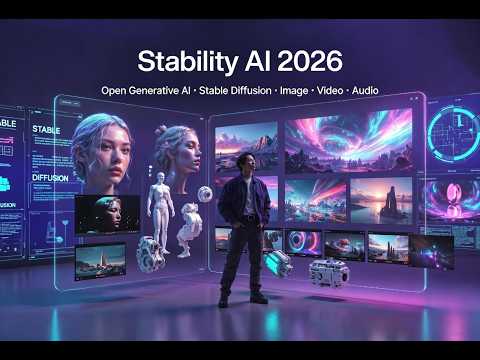

Stability AI Showcase



Stability AI — Frequently Asked Questions
What is Stability AI?
Stability AI is a generative media company that develops models and products for image, audio, video, 3D, and language. Users can access parts of its portfolio through downloadable weights, a managed API, web applications, cloud partners, self-hosted agreements, and enterprise services.
What is the current Stable Diffusion family?
Stable Diffusion 3.5 is the main current image-model family highlighted by Stability AI. The listed Core Models include Stable Diffusion 3.5 Medium, Large, and Large Turbo, alongside earlier Stable Diffusion, video, 3D, language, code, and audio models.
Is Stability AI free?
Some self-hosted Core Model use is free under the Community License, subject to its terms. The API, Stable Assistant, Stable Audio app, Brand Studio, cloud infrastructure, hardware, support, and enterprise licensing can all create separate costs.
Who qualifies for the Community License?
Stability AI says researchers, creators, developers, and businesses with less than $1 million in annual revenue can use listed Core Models under the Community License, including eligible commercial use. Commercial users above that revenue threshold must contact Stability AI for an Enterprise License. Read the current agreement for the complete conditions.
Does the license cover every Stability AI model?
No. The Core Models page is the controlling list for models included under Community and Enterprise agreements. Stability AI states that other models and versions are governed by their individual licenses, and the Core Models list can change.
How does API pricing work?
The developer API uses prepaid credits, with one credit equal to $0.01. A successful operation consumes a model-specific number of credits. New accounts receive 25 free credits, while enterprise users can ask about custom volume pricing.
What is Brand Studio?
Brand Studio is Stability AI's managed creative-production workspace. It combines generation, editing, precision tools, curated model routing, and enterprise options such as Brand Central, Brand ID Models, Campaigns, Producer Mode, SSO, and project access controls.
What is new in Stable Audio 3.0?
Stable Audio 3.0 is a 2026 model family for music and sound production. Stability AI offers Large for enterprise-grade production, Medium for open-weight full-song composition, and Small variants designed for lighter deployment, alongside API and web-app access.
Can I own and commercially use outputs?
Stability AI says that, as between the user and Stability AI, users own outputs from Core Models and derivative works, subject to applicable law, the Acceptable Use Policy, the relevant license, third-party rights, and any terms attached to a managed service or third-party model. This is not a guarantee that every output is legally risk-free.
Is Stability AI suitable for children?
The current Acceptable Use Policy says Stability AI technology is created for adults and requires users to be at least 18 or the minimum legal age in their location, whichever is higher. Schools and families should not assume the consumer services are designed for minors.
Sources & References
- Stability AI official website ↗
- Brand Studio plans ↗
- Stability AI Core Models ↗
- Stability AI licensing overview ↗
- Developer Platform pricing ↗
- Developer Platform getting started guide ↗
- Developer Platform API reference ↗
- Stable Diffusion 3.5 announcement ↗
- Stability AI API pricing update ↗
- Stability AI Acceptable Use Policy ↗
Try Stability AI
Visit the official website to get started with Stability AI today.
Visit Stability AI →