Surgitec Has a Platform, Not a Buying Case
Surge One still needs public clinical evidence
By WhatAI Editorial ·
The promise is broader than the evidence
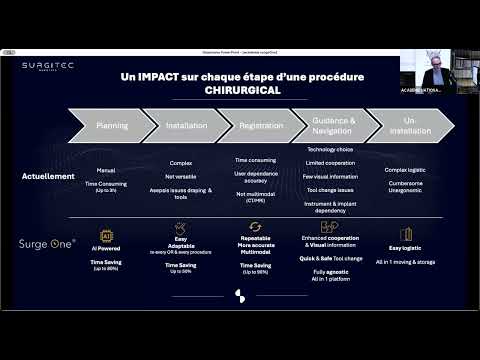
Surgitec Robotics has an idea that is easy to understand. Most surgical robots are associated with a narrow family of procedures, a particular anatomy or a specific hospital service. Surgitec wants one platform to support multiple hard-tissue specialties. Its current website presents an all-in-one robotic assistant with a scalable open architecture, a multi-specialty hub and a simplified user experience. It names brain, cranio-maxillofacial surgery, spine, orthopedics and ENT as the intended clinical territory.
The company now calls that platform Surge One. In a 2026 post from its official company page, Surgitec said it had showcased Surge One at VivaTech as a platform intended to expand access to robotic assistance for hard-tissue surgery. The VivaTech exhibitor listing describes it as a compact, open, AI-assisted and multi-specialty platform for neurosurgery, spine and orthopedics.
That is an ambitious product direction. It is not yet a complete buying case.
Public descriptions explain the vision, but they do not give hospitals the level of detail required for clinical procurement. The pages reviewed for this update do not publish procedure-level indications, regulatory clearances, accuracy data, device dimensions, compatible imaging systems, instrument catalogues, validation studies, installed-base figures, service commitments or pricing. Some of those materials may exist privately. Their absence from public pages does not prove that the work has not been done. It does mean that a responsible profile must separate what Surgitec says it is building from what has been independently demonstrated and cleared for clinical use.
What Surgitec actually says
The strongest current claims are architectural. Surgitec describes a single robotic platform for hard-tissue surgeries, built around open and scalable design. It positions the system as a multi-specialty hub rather than a robot tied to one department. The company also places unusual emphasis on usability, cost efficiency and wider access to robotic care.
Those goals make commercial sense. A hospital can struggle to justify several expensive robots if each one serves a limited case mix. A platform that could be shared across neurosurgery, spine, orthopedics, ENT and cranio-maxillofacial services might spread fixed costs across more procedures. A consistent interface could also reduce some duplication in training, support and operating-room planning.
The word might is important. Multi-specialty value depends on more than putting different software modules on one base. Each procedure family can involve different anatomy, tools, imaging, fixation, registration, accuracy requirements, sterile workflows and risk controls. A robot suitable for cranial trajectory guidance is not automatically suitable for bone cutting in orthopedics. A shared platform only produces genuine efficiency if its specialty configurations are clinically useful, regulated, supportable and available when each department needs them.
Surgitec's leadership provides relevant background. Its website identifies co-founder and chief scientific officer Professor Michel Lefranc as a neurosurgeon with long experience in surgical robotics and a major contributor to the design of the ROSA robot. Chief technology officer Florian Coiseur is described as having more than ten years of surgical-robotics experience, including innovation and intellectual-property leadership at Zimmer Biomet. The wider founding group includes specialists in pediatric neurosurgery, ENT, otology, cybersecurity and AI.
That experience makes the project credible enough to watch. It does not replace device evidence. Buyers should evaluate the actual Surge One configuration, not the resumes of the people building it.
Surge One and the logic of one robot
The practical attraction of Surge One is its proposed hub model. A compact platform with open interfaces could be easier to place in a constrained operating room, easier to connect with imaging and planning systems, and easier to reuse across services than multiple proprietary towers. Surgitec presents this as a route to wider adoption and better economics.
Open architecture, however, needs a precise definition. It could refer to software interfaces, compatibility with third-party imaging, interchangeable instruments, modular specialty applications or a commercial policy that avoids vendor lock-in. These are not equivalent. A procurement team should ask which interfaces are documented, which partners are validated, who owns integration responsibility and whether an update to one component can invalidate the approved configuration.
Compact also needs numbers. Hospitals should request the device footprint, mass, transport requirements, setup envelope, line-of-sight constraints, power needs, network needs, sterilization workflow and storage requirements. A robot that looks compact at a trade show may still create congestion once imaging, navigation, tables, anesthesia equipment and staff are included.
The same discipline applies to multi-specialty use. Ask which specialty is the first intended commercial indication, which procedures are in development, which are included in the regulatory submission and which remain roadmap concepts. A hospital should not model return on investment using five departments if only one approved workflow is available at launch.
AI is part of the story, not proof of performance
Surgitec and VivaTech use the term AI-assisted when describing the current platform. The company's public recruitment and event activity also connects its work with medical imaging and deep learning. That signals a serious interest in AI, but the public product pages reviewed here do not explain exactly what the model does inside Surge One.
AI could support image segmentation, anatomy recognition, surgical planning, trajectory proposals, registration, workflow guidance or safety monitoring. Each role carries different evidence and regulatory requirements. A planning suggestion can be reviewed before surgery. A model that influences a live robotic movement requires a much stronger account of latency, failure detection, human override and behavior outside the training distribution.
Hospitals should ask for an AI function map. For every model, Surgitec should be able to state the input data, output, intended user, clinical decision affected, confidence display, validation population, known limitations and fallback behavior. Teams should also understand whether the model changes after deployment, whether updates require new validation and how performance is monitored across scanners, sites and patient populations.
An AI label does not establish greater accuracy, better outcomes or lower operating-room time. Those are measurable claims that need appropriate studies. It is entirely possible for a useful surgical robot to employ limited AI, and it is possible for an impressive model to add little clinical value. The right question is not how much AI is inside Surge One. It is whether each automated function improves a defined task without creating a new and poorly controlled failure mode.
Availability is the central procurement question
The original WhatAI record described Surgitec as moving toward early commercialization and listed speculative enterprise pricing, add-on modules and recurring service contracts. That level of certainty is not supported by the current public pages. Surgitec invites contact and presents the platform at industry events, but it does not publish a catalogue price, a standard commercial package or a list of regions and procedures where Surge One can be purchased for clinical use.
For a medical device, availability is not a single yes-or-no status. A company can have a functioning prototype, an evaluation unit, a research installation, a limited clinical investigation and a commercially cleared system at different times. A hospital must verify the exact device version, intended use, jurisdiction and procedure. A demonstration in a laboratory or simulated operating room is not authorization for routine patient care.
Surgitec is based in France, so European buyers should request the applicable EU Medical Device Regulation status, notified-body details where relevant, approved intended purpose and instructions for use. Buyers elsewhere need the corresponding local authorization. Do not infer clearance from event participation, partnerships, hiring activity or the clinical credentials of the founders.
Pricing should also remain listed as unpublished. A serious total-cost model needs more than the capital price. It should include specialty modules, instruments, service, preventive maintenance, software, imaging integrations, training, proctoring, room modifications, cybersecurity work, sterile processing, downtime cover and any per-case consumables. If the platform is not yet commercially available, a hospital should distinguish research-partnership costs from a future purchase price.
How hospitals should evaluate it
The first step is to define a narrow intended use. Choose one procedure family, one department and one measurable problem. That might be planning consistency, instrument positioning, radiation exposure, setup time or access to a difficult trajectory. Avoid beginning with the claim that one robot will transform five specialties. Broad platform value can be assessed later, after the first workflow is understood.
Next, request a controlled product dossier. It should identify the exact hardware and software version, regulatory status, intended use, contraindications, technical specifications, accuracy method, safety architecture, instrument compatibility, imaging requirements, cybersecurity controls and evidence package. Ask which claims are validated, which are engineering targets and which remain roadmap items.
Then map the complete operating-room workflow. Observe patient positioning, imaging, registration, planning, draping, robot placement, instrument changes, surgeon interaction, emergency release, conversion to manual technique, cleaning and turnover. Time each stage. A faster robotic action does not save operating-room time if registration or equipment movement adds more minutes elsewhere.
Human factors deserve their own review. Surge One's public story emphasizes a revolutionary user experience, but ease of use must be tested with representative surgeons, nurses, radiographers, technicians and sterile-processing staff. Teams should examine alarm clarity, confirmation steps, mode awareness, handoffs, line of sight, accidental activation risks and recovery from interrupted workflows. Training should cover failure modes, not only the ideal demonstration.
Clinical and technical accuracy must be reported with context. Ask how accuracy is defined, where it is measured, the sample size, comparator, confidence intervals and performance across anatomy, imaging quality and users. A mean value can hide outliers that matter clinically. Teams should also distinguish robot repeatability from total-system accuracy, which includes imaging, registration, tracking, planning, tool calibration and patient movement.
Finally, conduct an economic review using only approved, supportable workflows. Estimate realistic annual case volume by specialty, room scheduling conflicts, utilization ramp, service coverage and downtime. Do not count theoretical future modules as current capacity. The hub model earns its advantage only when several departments can use the same system without creating bottlenecks or compromising training standards.
The comparison trap
Surgitec is often placed beside Intuitive Surgical's da Vinci, Stryker's Mako and Zimmer Biomet's ROSA family, but those comparisons can become misleading.
Da Vinci is primarily associated with robot-assisted minimally invasive soft-tissue surgery. Surgitec is describing a hard-tissue platform. The question is not whether Surge One can replace da Vinci in general, but whether a hospital's surgical mix justifies a separate hard-tissue capability.
Mako is closely associated with orthopedic joint-replacement workflows. ROSA spans established product families in areas such as brain, knee and spine. Surge One's proposed advantage is a more unified and open multi-specialty hub. Yet breadth on a roadmap cannot be compared directly with cleared indications, installed systems, training programs and published clinical experience. Procurement teams should compare one approved procedure at a time.
The most useful comparison table would include regulatory status by procedure, system accuracy, evidence quality, imaging dependencies, instrument freedom, footprint, setup time, training, service response, cybersecurity, capital price and per-case cost. Until Surgitec publishes or privately supplies those details, any ranking is premature.
The WhatAI view
Surgitec Robotics is a credible emerging company with a compelling product thesis. Surge One is being presented as a compact, open and AI-assisted hub for hard-tissue surgery, supported by a founding team with relevant surgical and robotics experience. The ambition to let several specialties share one platform addresses a real economic and operational problem.
The current evidence gap is equally real. Public materials are still dominated by mission, architecture and team credentials. They do not yet let an independent reader verify procedure-level availability, regulatory status, clinical performance, detailed specifications, pricing or total cost of ownership. For that reason, WhatAI should describe Surgitec as an emerging platform under evaluation, not as a proven system already performing the procedures in the original record.
Hospitals interested in Surge One should make contact, but the next step is diligence rather than purchase. Ask for the exact intended use, evidence dossier, regulatory pathway, AI function map, workflow data and commercial assumptions. Run a simulated evaluation with the people who will operate, clean, support and govern the system. Keep future specialty modules outside the financial case until they are cleared and available.
Surgitec may eventually demonstrate that one well-designed hard-tissue robot can serve several departments without the compromises that usually accompany general-purpose platforms. That would be meaningful. Until the company provides the evidence needed to test that proposition, the honest verdict is promising, relevant and too early for confident procurement conclusions.
Surgitec Robotics is developing Surge One, a compact, open and AI-assisted platform intended for hard-tissue surgery across brain, cranio-maxillofacial, spine, orthopedic and ENT specialties. The multi-specialty hub is designed to improve access and utilization, but public product, regulatory, clinical and pricing details remain limited.
What Hospitals Can Verify Today
The company publicly confirms the all-in-one hard-tissue strategy, open architecture, multi-specialty scope and experienced surgical-robotics team. It does not currently publish the procedure-level indications, regulatory authorizations, technical specifications, clinical studies, installed-base data or standard pricing needed for a full procurement comparison.
Is Surge One Ready for Procurement?
Hospitals should contact Surgitec for the exact device version, intended use, regulatory status, evidence dossier, AI function map, imaging compatibility, training model, service coverage and total cost. A trade-show demonstration or development partnership should not be treated as authorization for routine clinical use.
About Surgitec Robotics
Surgitec Robotics is a French medical robotics company developing Surge One, a compact, open and multi-specialty robotic platform for hard-tissue surgery. The company targets brain, cranio-maxillofacial, spine, orthopedic and ENT applications and describes the system as AI-assisted. Public information currently focuses on the platform vision, architecture and experienced founding team. Detailed specifications, procedure-level regulatory status, clinical performance, installed-base information and pricing are not publicly disclosed, so hospitals should treat Surge One as an emerging system requiring direct technical, regulatory and commercial diligence.
Use Cases
Key Features
- ✓ Surge One robotic platform
- ✓ Hard-tissue surgery focus
- ✓ Compact multi-specialty hub concept
- ✓ Scalable open architecture
- ✓ AI-assisted robotics positioning
- ✓ Target applications across brain, CMF, spine, orthopedics and ENT
- ✓ User-experience and wider-access design goals
Pricing
Surge One
Contact company; pricing not public
- • Direct product and partnership inquiry
- • Regional and procedure availability require confirmation
- • Configuration, training, service and integration costs are not publicly listed
Pricing varies by plan and region — see current pricing.
Plan features change — last updated: 2026-08-25.
Details
Tags
Surgitec Robotics Community Discussions
Explore community discussions. Ask and answer questions on Surgitec Robotics to grow and learn together.



Surgitec Robotics Showcase



Surgitec Robotics — Frequently Asked Questions
What is Surge One?
Surge One is the robotic platform being developed by Surgitec Robotics. The company presents it as a compact, open and multi-specialty assistant for hard-tissue surgery.
Which specialties does Surgitec target?
The official website names brain, cranio-maxillofacial, spine, orthopedics and ENT. Buyers must still confirm which procedures are currently validated, regulated and available.
How does AI support Surge One?
Surgitec and VivaTech describe the platform as AI-assisted, but the public pages reviewed do not provide a detailed map of the AI functions, inputs, outputs or validation. Hospitals should request that information directly.
Is Surge One commercially available?
Public sources show active development and industry demonstrations but do not provide a standard purchase package or a procedure-by-procedure availability list. Confirm the exact regulatory and commercial status with Surgitec for your region.
How much does Surge One cost?
Surgitec does not publish pricing. A hospital should request capital, module, instrument, integration, training, service, software and per-case costs before modelling return on investment.
Can Surge One replace da Vinci?
Not as a general comparison. Surgitec targets hard-tissue procedures, while da Vinci is primarily used for minimally invasive soft-tissue surgery. Compare systems by approved procedure and clinical need.
How does it compare with Mako or ROSA?
Surge One proposes a broader open hub, while Mako and ROSA have established procedure-specific product families. A fair comparison requires regulatory status, evidence, accuracy, workflow, service and cost data for the same procedure.
What should hospitals request first?
Request the intended use, regulatory documentation, technical specifications, clinical evidence, AI function map, compatible imaging and instruments, cybersecurity controls, training plan, service model and total cost.
Sources & References
Try Surgitec Robotics
Visit the official website to get started with Surgitec Robotics today.
Visit Surgitec Robotics →