BabyLoveGrowth is turning SEO automation into a full operating loop
The $99 platform now links daily publishing, backlink exchange, AI visibility, site health, Reddit and Quora discovery, while its backlink and refund mechanics deserve closer scrutiny.
By WhatAI Editorial ·
BabyLoveGrowth is trying to turn SEO into an operating system you switch on
Most SEO software still assumes there is a human team behind the dashboard.
The product finds a keyword gap, somebody decides whether the topic is worth pursuing, a writer creates the article, an editor reviews it, a developer or marketer publishes it, an outreach process earns links, and another tool measures whether any of it worked.
BabyLoveGrowth is built around removing as many of those handoffs as possible.
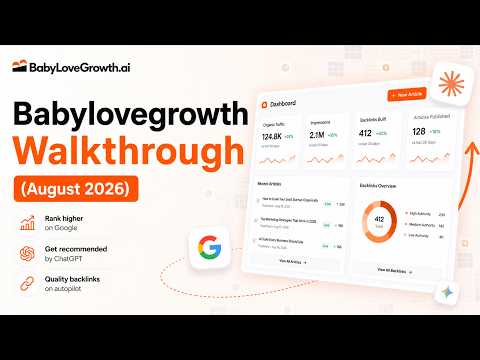
The current 2026 platform describes itself as an all-in-one GEO and SEO system for organic growth on autopilot. It analyzes the business, builds a 30-day content plan, creates and publishes articles, places contextual backlinks through its network, checks technical site health, tracks visibility in AI answers and identifies Reddit and Quora conversations where the brand may be relevant.
That makes BabyLoveGrowth more than an AI blog writer.
It is closer to an automated content and authority operation.
For a founder or small marketing team, that can be attractive because the cost of SEO is rarely one subscription. It is the combined cost of strategy, writing, editing, publishing, link acquisition, monitoring and technical maintenance.
BabyLoveGrowth's promise is that a $99 monthly plan can absorb a meaningful portion of that routine work.
The tradeoff is equally important.
The more of the SEO process a system automates, the more important it becomes to understand what it is doing on your behalf.
The product now publishes thirty articles a month
The current Grow plan includes 30 SEO and AI-optimized articles per month.
That is roughly one new article every day.
BabyLoveGrowth says the content engine begins by analyzing the business, audience, niche and competitors. It then performs keyword research and SERP-based clustering, looks at the structures of current ranking pages and selects an article format based on search intent.
The platform currently documents several content types, including how-to articles, explainers, educational listicles, product roundups and comparisons.
The important part is not the number thirty.
It is what happens before and after generation.
A typical AI writing tool waits for a user to decide what article to create. BabyLoveGrowth attempts to select the topics, generate the article, add internal links, citations, imagery and structured elements, then send the final semantic content to the connected website.
That is why the platform feels more like content operations than content generation.
It also explains why editorial oversight matters.
Publishing thirty articles per month creates enough volume for small content-quality problems to become site-wide patterns. A weak factual claim in one manual article is one weak claim. A weak content rule repeated across a year of automated publishing can affect hundreds of pages.
Independent 2026 testing is useful here.
Aboah Reviews says it tested the system for 45 days across three projects and found the output strongest in general commercial and ecommerce topics, while technical material required significantly more editing. Seller Stacked similarly describes the system as effective for informational ecommerce content but recommends editorial oversight in regulated categories.
Those are independent reviewer claims rather than controlled benchmarks, but they support a sensible operating principle.
Treat the system as an automated publishing engine with review requirements that should scale with subject-matter risk.
A recipe article and a financial-regulation article should not receive the same approval process.
The backlink network is the feature buyers should examine most carefully
BabyLoveGrowth's backlink system is one of the main reasons the $99 plan looks unusually comprehensive.
The company says its network contains thousands of participating websites. Its current product pages refer to more than 4,000 partner sites, while parts of the documentation still reference a smaller network size.
The underlying model is credit based.
A participating website earns credits when BabyLoveGrowth places an outbound backlink from one of its articles to another network member. The site then spends credits when it receives a backlink.
The documentation says links are contextually inserted into relevant daily articles and that the network uses dofollow links.
New accounts begin with 100 backlink credits. The documentation currently states that giving a backlink earns credits according to the site's domain rating, capped at 20 credits per link, while receiving a link spends credits according to the giving site's domain rating.
Optional backlink subscriptions can add 100, 300 or 600 credits per month for $100, $300 or $600 respectively.
That mechanism deserves careful treatment because Google's spam policy explicitly lists excessive link exchanges and the use of automated programs or services to create links as examples of link spam when the primary purpose is manipulating rankings.
BabyLoveGrowth argues that its network is contextual and not a simple direct reciprocal exchange. Some customers may link to different sites rather than directly swapping links with the same domain.
That distinction can reduce the obvious footprint of a direct "link to me and I will link to you" arrangement.
It does not create a blanket exemption from Google's policy.
Google's current wording focuses on the purpose and pattern of the links, not only whether A links directly back to B.
The WhatAI position should therefore be careful.
Do not describe BabyLoveGrowth's network as unsafe by definition.
Do not describe it as risk-free either.
A buyer should inspect the actual outbound and inbound links, relevance, anchor text, article quality, domain quality and whether the linking pattern looks primarily editorial or primarily designed to transfer ranking signals.
This is particularly important for businesses where organic search is commercially critical.
The backlink feature can be valuable.
It is also the part of the product that deserves the most governance.
AI visibility is now built into the same dashboard
BabyLoveGrowth does not only optimize for conventional search.
Its dashboard includes LLM visibility tracking across systems such as ChatGPT, Claude, Perplexity and Gemini.
The platform's analytics documentation describes a visibility score based on how often the monitored brand appears across the answers generated for tracked prompts. Users can inspect individual prompts, see competing brands, review sources and read the returned AI responses.
That is directionally useful.
Traditional web analytics only sees an AI assistant when a user actually clicks through to the website. A brand can be recommended inside an answer without generating a visit.
Prompt monitoring gives teams a way to observe that otherwise invisible layer.
The limitation is variability.
AI responses can change between runs. Different prompts, model versions, locations and timing can produce different brands and different sources.
BabyLoveGrowth's own Academy now gives the right advice here: watch the trend rather than treating one snapshot as definitive.
An independent August 2026 analysis from OrganikPi also found materially different visibility scores for the same test domain across two BabyLoveGrowth surfaces on the same day.
That does not necessarily make either number wrong.
It demonstrates why AI visibility should be treated as a sampling system rather than a fixed ranking position.
The useful question is whether the brand's visibility is improving across a stable, commercially relevant prompt set over time.
Technical GEO has become part of the package
BabyLoveGrowth's Site Health area checks technical factors that may affect conventional search and AI discovery.
The current documentation lists llms.txt, JSON-LD schema, robots.txt, sitemap health, SSL, titles, meta descriptions, broken links and other checks.
The broader dashboard combines these into site health, page-speed, LLM optimization and SEO optimization views.
This is a good addition because content automation cannot fix a site that search engines cannot crawl or understand properly.
It is also important not to overstate what some of these signals mean.
An llms.txt file is not a universal ranking requirement for AI assistants.
A valid schema implementation does not guarantee citations.
Technical accessibility is the foundation.
It is not the complete explanation for why one brand appears in an AI answer and another does not.
The technical audit is best used to remove obvious blockers rather than as a scoring system that promises visibility by itself.
Reddit and Quora are becoming another optimization channel
One of the more unusual current features is the social-opportunity layer.
The dashboard now includes controls for both Reddit and Quora.
Users can define monitored keywords, narrow Reddit monitoring to selected communities and tell BabyLoveGrowth how suggested replies should sound.
The platform's current homepage describes the agent as identifying Reddit and Quora posts that may be useful for brand visibility, then suggesting comments that naturally mention the brand.
This fits the broader GEO strategy.
Reddit threads and community discussions are frequently visible in traditional search and can also appear as cited sources in AI answers.
Being present in relevant discussions can therefore create real brand discovery.
The quality boundary is obvious.
There is a large difference between helping an expert discover a relevant discussion and automating promotional replies into communities.
Reddit and Quora both have community expectations around self-promotion, disclosure and usefulness.
A brand mention should be earned by the substance of the answer.
The user should review every suggested contribution and post it only when it genuinely answers the question.
The platform can find the opportunity.
It should not become a license to manufacture astroturfed recommendations.
Publishing coverage is broader than many autoblog tools
BabyLoveGrowth has expanded the number of publishing routes considerably.
Its current documentation lists WordPress, WordPress.com, Shopify, Webflow, Wix, Ghost, Framer, GoHighLevel, Duda, BigCommerce and Snapps.
Developers can use the REST API, webhooks or a Next.js package.
For websites built with products such as Lovable, Bolt, v0, Replit and Base44, BabyLoveGrowth recommends its hosted-blog option when a native CMS connection is not available.
That breadth matters because publishing friction is where many AI content systems stop being automated.
Generating an article and leaving it in a dashboard still requires an operator.
BabyLoveGrowth is specifically trying to close that last mile.
The recent Framer Marketplace plugin, published in July 2026, is another sign that the company is investing in broader publishing coverage rather than assuming every customer uses WordPress.
Analytics connections currently include Google Search Console and Google Analytics 4.
The settings documentation says Search Console access is view only.
The $99 plan is unusually aggressive
BabyLoveGrowth's current monthly pricing is straightforward.
Grow is advertised at $99 per month, discounted from a displayed $247 anchor price.
Scale is $299 per month, discounted from $599.
The pricing interface also offers annual billing at a 25 percent discount.
Grow includes the thirty monthly articles, publishing integrations, automated keyword research, the backlink network, AI visibility optimization, technical site auditing, citation tracking and the Reddit agent.
Scale adds a dedicated SEO and GEO specialist, two hours of monthly strategy support, three additional content languages, priority support and early access to beta features.
For agencies, there is also a white-label offer.
The current white-label documentation lists a $2,000 one-time setup fee plus $99 per website per month. The agency can host the dashboard under its own domain and apply its own branding.
At face value, the pricing is difficult for a conventional SEO agency to match because BabyLoveGrowth is bundling software, content production and link activity into one subscription.
That does not mean the price automatically represents value.
The economic comparison depends on how much of the output the customer can actually use without correction.
If a team publishes all thirty articles and the backlink profile remains healthy, the cost per usable asset is low.
If editors have to rewrite most of the output, remove weak pages or audit problematic links, the real cost rises.
The refund messaging has a material contradiction
This is one of the most important buying details on the current site.
The pricing page and homepage prominently advertise a 90-day money-back guarantee tied to organic traffic growth.
The current Terms of Use say something different.
The terms state that users receive a three-day free trial, that subscriptions are recurring and that refunds are not offered after the trial because of external API and AI-service costs.
The terms then describe exceptional refund review for bugs, errors or situations where the service is not as advertised.
Those statements do not cleanly match the marketing promise that a customer receives a refund if organic traffic does not grow within 90 days.
Independent reviewers have noticed the same conflict.
WhatAI should not resolve it on BabyLoveGrowth's behalf.
The correct buying guidance is simple.
If the 90-day traffic guarantee is important to your decision, ask BabyLoveGrowth to confirm the exact eligibility criteria and refund procedure in writing before purchasing.
A guarantee is only useful when both sides agree on what the guarantee means.
The affiliate program is unusually attractive
BabyLoveGrowth operates an official affiliate program through Reditus.
The current public page advertises a 60-day cookie and recurring commission for the first 12 months of each referred customer's payments.
The starting affiliate tier pays 25 percent.
Five or more paying customers raises the rate to 30 percent.
Fifteen or more raises it to 35 percent.
The program also advertises instant approval, monthly payouts and permission to use paid ads.
That commercial structure matters when researching the product.
A large number of positive reviews may contain affiliate links because the economics are attractive.
That does not make those reviews dishonest.
It does mean readers should distinguish between hands-on testing, vendor case studies and promotion.
For WhatAI, the programme should be documented transparently while leaving the actual affiliateLink field empty until WhatAI has its own verified tracking URL.
WhatAI's view
BabyLoveGrowth is one of the more ambitious attempts to make SEO operationally autonomous.
Its strongest feature is not the AI writer.
The interesting part is the chain.
Business analysis feeds the content plan.
The content plan feeds daily publishing.
The published pages feed internal linking and backlink eligibility.
Search Console and AI visibility feed measurement.
Technical checks surface blockers.
Reddit and Quora monitoring create another distribution channel.
For a small team that would otherwise do very little SEO because the process is too fragmented, that can be genuinely valuable.
The risks come from exactly the same automation.
Thirty articles per month can create thirty useful assets or thirty mediocre ones.
An automated backlink network can create authority signals or a linking pattern a search engine decides is manipulative.
Suggested community replies can create useful participation or obvious promotional noise.
An AI visibility score can reveal a trend or encourage overconfidence in a noisy metric.
BabyLoveGrowth therefore should not be judged by how little work the user has to do.
It should be judged by how much low-value work the system removes while preserving human judgment where it still matters.
The best trial is not to switch everything on and wait for a traffic chart.
Connect a real site.
Inspect the proposed 30-day content plan before publishing.
Review the first few articles for factual depth, commercial relevance and originality.
Inspect every backlink you receive and several of the outbound links the network places from your own site.
Check Search Console rather than relying only on vendor metrics.
Build a stable list of buyer prompts for LLM visibility.
Review Reddit and Quora suggestions manually.
Then calculate how many hours of strategy, writing, publishing, monitoring and link work the platform actually removed.
If BabyLoveGrowth can automate the repetitive work without filling the site with content or links you would not have approved yourself, $99 per month is a compelling price.
If the team has to supervise every output as heavily as it would supervise separate freelancers and tools, the autopilot advantage becomes much smaller.
That is the real decision.
BabyLoveGrowth does not remove the need for SEO judgment.
It moves that judgment from producing every task manually to deciding whether the machine should be allowed to keep doing what it is doing.
BabyLoveGrowth automates much more than article writing. The current $99 Grow plan combines a 30-day strategy, 30 monthly articles, CMS publishing, backlink exchange, technical SEO and GEO audits, AI visibility tracking, citation monitoring and Reddit opportunity discovery.
What BabyLoveGrowth is actually best at
BabyLoveGrowth is best suited to founders, ecommerce brands, SaaS teams and agencies that want a repeatable organic-growth operation without coordinating separate writers, publishing tools, backlink outreach and AI-visibility dashboards. Its value comes from connecting the workflow rather than from any single feature.
Where BabyLoveGrowth needs the most scrutiny
The automated backlink exchange deserves careful review against Google's link-spam policy, automated publishing still requires editorial governance, AI-visibility scores should be treated as trend data rather than fixed rankings, and the site's 90-day refund marketing does not cleanly match the refund language in its current Terms of Use.
About BabyLoveGrowth
BabyLoveGrowth is an automated SEO and generative engine optimization platform that plans, writes and publishes content, builds backlinks through a credit-based partner network, audits technical SEO and GEO health, tracks brand visibility in AI answers, and surfaces Reddit and Quora conversations where a brand may be relevant. Its core proposition is operational automation rather than a standalone AI writer: Grow currently includes 30 articles per month, publishing integrations, keyword research, backlink activity, AI citation tracking and site auditing for $99 per month.
Use Cases
Key Features
- ✓ 30-day automated SEO and GEO content plan
- ✓ 30 SEO and AI-optimized articles per month on Grow
- ✓ SERP-based keyword research and clustering
- ✓ Brand-tone and product-aware article generation
- ✓ Automated internal linking
- ✓ Citation-backed article generation
- ✓ Images, infographics, FAQs and structured article elements
- ✓ Automatic publishing to supported CMS platforms
- ✓ Credit-based contextual backlink exchange network
- ✓ Backlink tracking and domain-rating monitoring
- ✓ LLM visibility tracking across major AI answer systems
- ✓ Prompt-level brand, competitor, source and answer monitoring
- ✓ Technical SEO and GEO site-health audits
- ✓ llms.txt, schema, robots.txt, sitemap and metadata checks
- ✓ Reddit AI Agent for conversation discovery and suggested replies
- ✓ Quora monitoring and suggested-answer workflows
- ✓ Google Search Console analytics
- ✓ Google Analytics 4 integration
- ✓ REST API, webhooks and Next.js publishing options
- ✓ White-label agency platform
Pricing
Grow
$99 per month
- • Three-day free trial
- • 30 SEO and AI-optimized articles per month
- • Automated publishing
- • Backlink network access
- • AI visibility optimization
- • AI citation tracking
- • Technical site audit
- • Reddit AI Agent
- • Automated keyword research and SERP clustering
- • Annual billing currently advertises a 25 percent discount
Scale
$299 per month
- • Everything in Grow
- • Dedicated one-to-one SEO and GEO specialist
- • Two hours of strategy support per month
- • Three additional content languages
- • Priority same-day support
- • Early access to beta features
- • Annual billing currently advertises a 25 percent discount
White-label
$2,000 setup + $99/site/month
- • Everything in the Grow workflow
- • Dashboard hosted on the agency's domain
- • Agency logo, colors and branding
- • Client access to content, backlinks, audits and analytics
- • Bulk discounts available for additional websites
- • Current documentation says setup typically takes several business days
Backlink credit add-ons
$100, $300 or $600 per month
- • Optional subscription separate from the main backlink credit earning system
- • 100, 300 or 600 bonus backlink credits per month
- • Credits roll over month to month
- • Documentation says subscription capacity is limited to 20 slots across the platform
Pricing varies by plan and region — see current pricing.
Plan features change — last updated: 2026-08-26.
Details
Tags
WhatAI verdict on BabyLoveGrowth
BabyLoveGrowth — Frequently Asked Questions
What is BabyLoveGrowth?
BabyLoveGrowth is an automated SEO and GEO platform that plans, generates and publishes content, builds backlinks through a partner network, audits site health, tracks AI visibility and surfaces social opportunities.
How much does BabyLoveGrowth cost?
As of August 26, 2026, Grow is $99 per month and Scale is $299 per month on monthly billing. The pricing page also advertises a 25 percent annual discount.
Does BabyLoveGrowth have a free plan?
The main subscription does not have a permanent free tier. The current plans offer a three-day trial, while BabyLoveGrowth also provides several free SEO and GEO audit tools.
How many articles does BabyLoveGrowth publish?
The current Grow plan includes 30 SEO and AI-optimized articles per month, with automatic publishing to supported website platforms.
Which CMS platforms does BabyLoveGrowth support?
Current documentation includes WordPress, WordPress.com, Shopify, Webflow, Wix, Ghost, Framer, GoHighLevel, Duda, BigCommerce and Snapps, plus API, webhooks, Next.js and hosted-blog routes.
How does the BabyLoveGrowth backlink exchange work?
Participating sites earn credits when the network places outbound links from their articles and spend credits when they receive backlinks. The documentation says links are contextual and dofollow.
Is BabyLoveGrowth's backlink network safe for Google SEO?
It should not be treated as automatically safe or automatically penalized. Google explicitly lists excessive link exchanges and automated link-creation services as potential link spam, so buyers should inspect the actual links, relevance and network behavior.
Does BabyLoveGrowth track ChatGPT and other AI systems?
Yes. Its LLM visibility tools monitor brand mentions, competitors, sources and answer responses across major AI systems including ChatGPT, Claude, Perplexity and Gemini.
What is the BabyLoveGrowth Reddit AI Agent?
It finds Reddit discussions relevant to monitored keywords and can suggest replies based on the brand's preferred tone. Users should review suggestions and follow community rules rather than treating the feature as automated promotion.
Does BabyLoveGrowth offer a 90-day money-back guarantee?
The marketing site advertises a 90-day traffic guarantee, but the current Terms of Use says refunds are generally unavailable after the three-day trial except for exceptional review cases. Buyers should confirm the guarantee terms in writing.
Does BabyLoveGrowth have an affiliate program?
Yes. Its official Reditus program currently pays 25 percent recurring commission for 12 months, rising to 30 percent after five paying referrals and 35 percent after fifteen, with a 60-day cookie.
Is BabyLoveGrowth suitable for regulated or high-stakes content?
Automated output should receive stronger subject-matter and factual review in regulated, medical, financial, legal or other high-stakes categories. Independent reviewers have reported greater editing requirements in technical niches.
Sources & References
- Official BabyLoveGrowth platform overview ↗
- Official BabyLoveGrowth pricing ↗
- Official BabyLoveGrowth documentation ↗
- Official article quality documentation ↗
- Official backlink network and credit documentation ↗
- Official Site Health and technical audit documentation ↗
- Official Google and LLM analytics documentation ↗
- Official settings, analytics, Reddit and Quora documentation ↗
- Official publishing and analytics integration documentation ↗
- Official white-label agency pricing ↗
- Official white-label documentation ↗
- Official BabyLoveGrowth affiliate program ↗
- Official BabyLoveGrowth Terms of Use ↗
- Official free LLM citation checker ↗
- Official AI visibility tracking guidance ↗
- Official Framer Marketplace BabyLoveGrowth plugin ↗
- Google Search spam policies covering link exchanges and automated link creation ↗
- Independent August 2026 BabyLoveGrowth backlink network analysis ↗
- Independent 45-day BabyLoveGrowth review ↗
- Independent ecommerce BabyLoveGrowth review ↗
- Official BabyLoveGrowth product demo ↗
- Official BabyLoveGrowth 2026 SEO and GEO platform overview ↗
- Official BabyLoveGrowth all-in-one AI search SEO overview ↗
Try BabyLoveGrowth
Visit the official website to get started with BabyLoveGrowth today.
Visit BabyLoveGrowth →