Eurekaa is making course creation start with market evidence instead of an AI prompt
A 330K-course research layer, Crowd Insights and Rapid Publisher now surround Lesson Architect, making validation and original expertise more important than raw generation speed.
By WhatAI Editorial ·
Eurekaa is trying to make course creation start with market evidence instead of an AI prompt
Most AI course tools begin in the same place.
The creator types a topic.
The software produces an outline.
The outline becomes lessons, quizzes, worksheets and sometimes a finished course.
That workflow is fast, but it starts with an assumption: the creator already chose the right problem to teach.
Eurekaa is built around the opposite idea.
Before generating the course, research the market.
The current platform combines a cross-platform course database, topic scoring, book research, keyword demand, review analysis, Reddit audience research, a content workspace, AI lesson generation and a lightweight course publisher.
That sequence matters.
Eurekaa is not strongest when it behaves like another AI writer.
It is strongest when it gives a creator evidence before the writing begins.
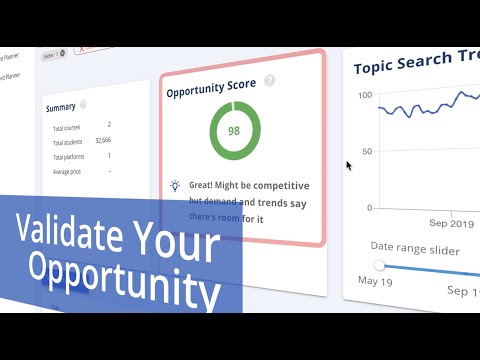
The current homepage says its database covers 330,000 courses, 1.8 million niches and 40 million books. Its April 2026 topic analysis says the 330,000-course dataset spans 11 platforms and uses enrollment, supply density, platform distribution and 24-month search-trend movement to calculate an Opportunity Score.
That turns course ideation into a market-research problem rather than a brainstorming problem.
The buying question is therefore not simply whether Eurekaa can create a curriculum quickly.
It is whether the data is useful enough to change what the creator decides to build.
Topic validation is still the product's clearest advantage
A normal course-market research workflow is fragmented.
A creator searches Udemy.
Then Coursera.
Then Skillshare.
Then Google Trends.
Then keyword tools.
Then books.
Then Reddit.
Then spreadsheets.
Each source answers a different question.
Does demand exist?
How much competition exists?
What titles are working?
How many people enrolled?
What are students complaining about?
Which subtopics are missing?
What language do buyers use?
Eurekaa tries to put those signals in one workspace.
Its Course Comparison Engine lets users search and compare courses across major learning platforms.
Current public material names Udemy, Coursera, Skillshare, LinkedIn Learning, edX, Domestika, Alison, Udacity, CreativeLive, Spotlight by Teachable and Lurn.
The platform exposes fields such as enrollment, ratings, reviews, categories, search demand and estimated revenue where available.
It then adds topic-level scoring.
The current 2026 topic methodology describes the Opportunity Score as a composite of student demand, course supply density, platform distribution breadth and search-trend trajectory.
That is useful because high demand alone can be misleading.
A large market with thousands of established courses may be harder to enter than a smaller but rapidly growing subject with less supply.
The important word is directional.
Eurekaa itself describes its scoring as directional validation.
That is the correct interpretation.
An Opportunity Score is not a forecast of course revenue.
It is a way to compare the evidence surrounding topics before investing months in production.
A creator should still validate the offer, audience, price and distribution strategy independently.
The course database numbers are not perfectly synchronized across current pages
Eurekaa's newer homepage and April 2026 topic report say 330,000 courses and 1.8 million niches.
Other current official surfaces contain older counts.
The How It Works page says more than 297,000 courses and more than 600,000 categories.
The pricing page still contains copy referring to more than 200,000 courses and more than 400,000 course categories.
Those numbers are all on Eurekaa-owned pages.
The most likely explanation is that the database has grown while older marketing sections have not been updated.
WhatAI therefore uses the newer 330,000-course and 1.8-million-niche figures as the current headline, while treating the exact database size as a moving vendor-reported metric rather than a fixed audited number.
This matters because database breadth is central to Eurekaa's positioning.
A buyer should care less about whether the exact count is 297,000 or 330,000 than whether the relevant platforms and topics are represented well enough for the course they want to research.
That can be tested quickly during the trial.
Search several niches the creator already understands.
Compare the results with the actual marketplaces.
Look for missing platforms, duplicate listings, stale enrollment figures or obviously incomplete categories.
The data should earn trust before it drives strategy.
Crowd Insights adds audience pain to market sizing
One of the most useful additions to the current product is Crowd Insights.
Instead of only showing what courses already exist, the feature pulls real questions, comments and frustrations from Reddit.
Eurekaa says AI groups similar questions into themes, estimates how often they appear and scores the intensity of the frustration.
Users can open the original Reddit thread when a question looks important.
That creates a different kind of research signal.
Course databases show supply and historical demand.
Reddit discussions can show language, confusion and unresolved pain.
For a creator, that can reveal the gap between the curriculum competitors offer and the problem learners are actually trying to solve.
This is where Eurekaa's data-first model becomes more valuable than simple course cloning.
Eurekaa's own 2026 editorial direction reinforces this.
Its article on AI-made courses argues that creators should use AI for structure, quizzes, editing and supplemental materials while keeping practitioner expertise at the center of the teaching.
That is a healthier position than promising a profitable course generated from one click.
The product increasingly works best when research improves the creator's original expertise rather than replacing it.
Gap analysis is useful only if the creator understands the underlying content
Eurekaa includes AI Gap Analysis and sentiment analysis around published courses and reviews.
The goal is to identify what popular content covers, what customers like or dislike and where the market may have unmet needs.
This can speed up curriculum planning substantially.
It can also create false confidence.
Gap analysis should therefore generate questions for the creator, not final curriculum decisions.
The person with domain expertise still needs to decide what belongs in the learning journey.
This is particularly important in technical, medical, legal, financial or regulated subjects where completeness and factual accuracy matter more than content novelty.
Lesson Architect is more useful when it starts from proprietary material
Eurekaa's Lesson Architect is designed to turn a topic, audience level, length and context into structured course or book content.
The current homepage now emphasizes proprietary frameworks, contrarian insights and signature techniques rather than generic AI generation.
Users can also upload PDFs, DOCX files or messy notes and ask the system to structure them into a course or book.
That is the right direction.
The easiest content for an AI to generate is also the easiest content for every competitor to generate.
A generic introduction to photography, marketing, leadership or prompt engineering is becoming close to a commodity.
A creator's defensible material is their process, examples, failures, frameworks, data and judgment.
Eurekaa becomes more useful when Lesson Architect acts as a structuring layer for that material.
There is still a normal generative-AI limitation.
AI can hallucinate.
An AppSumo discussion in 2025 included a customer questioning the depth of generated content, and founder Larry Weeks explicitly acknowledged that hallucinations can occur even with retrieval-based workflows.
That is a useful admission.
Lesson Architect should be treated as a drafting and structuring system, not a source of truth.
The creator remains responsible for factual review.
Rapid Publisher makes Eurekaa a lightweight delivery platform
Eurekaa no longer stops at research and outlining.
Rapid Publisher can turn lesson content into a functioning course.
Users can add video or audio, resources and quizzes.
Courses can be published behind a password-protected URL or embedded on another website.
The platform can also export SCORM packages for delivery through another LMS.
This changes Eurekaa's role.
A creator can research a topic, build a curriculum, draft content and launch a Minimum Viable Course without moving immediately into a larger LMS.
That can be useful for validation.
A course creator may not need advanced community features, certificates, cohort management or a large learning platform before proving that people want the material.
Rapid Publisher can therefore be evaluated as an MVP delivery layer.
The SCORM export is particularly important for users that do need a more established LMS later.
The limitation is that Eurekaa should not automatically be treated as a replacement for every learning-management platform.
The current product is centered on research, creation and fast publishing.
Organizations needing complex enrollment administration, enterprise identity, certifications, compliance training, deep assessment logic or advanced learner analytics should test those requirements separately.
The Creator plan is where Eurekaa becomes a creation platform
Current annual pricing begins with Researcher at $14 per month.
Researcher includes the research stack: Course Comparison, Topic Viability Scoring, Gap Analysis, Platform Research, Book Search, Content Library and 60 Keyword Planner credits per month.
Creator costs $16 per month when billed annually.
It adds workspace tags, 90 monthly Keyword Planner credits, the AI-assisted document editor, Lesson Architect and Rapid Publisher.
There is also a $39 month-to-month option that currently says it includes everything in Creator.
Pro costs $44 per month billed annually and adds team collaboration for up to three team members.
For most creators building a course rather than only researching an idea, Creator is the logical reference plan.
The difference between $14 and $16 is small.
The meaningful distinction is access to creation and publishing.
Pro is a much larger price jump and is mainly justified by collaboration.
Refund rules are stricter than the friendly pricing page language suggests
The pricing page says cancel anytime.
The April 2024 Terms are more specific.
Subscriptions renew until cancelled.
The user must cancel before the next billing date to avoid renewal.
Payments are generally non-refundable and there are no credits for partially used periods.
The Terms provide a narrow first-purchase refund-consideration window tied to the initial trial and require contacting support within the stated period.
Renewals are not eligible under that exception.
This is not unusual for SaaS.
It is worth knowing before selecting an annual plan.
The larger concern is document age.
The Terms were last updated in April 2024.
The Privacy Policy is also several years old.
Since then, Eurekaa has expanded materially into generative AI, uploaded source files, Reddit-derived Crowd Insights, AI publishing and other workflows.
The public legal documents do not clearly explain the current model-provider architecture or all of the newer AI processing paths.
That does not prove a privacy problem.
It does mean the legal documentation is older than the current product.
Organizations uploading proprietary course material should ask how those files and prompts are processed, which AI providers receive them, what retention applies and whether data can be used for model improvement.
The current Terms do provide two useful points.
Users retain ownership of Customer Data.
Eurekaa receives licenses necessary to operate the service and a broad perpetual analytics license over Customer Data.
That analytics clause deserves review from organizations uploading valuable proprietary frameworks.
Platform policy makes human expertise more important in 2026
Eurekaa's own April article on AI-made courses is one of the most useful pieces of editorial content on the site.
The article argues that course marketplaces are becoming less tolerant of low-quality fully AI-generated courses and that creators should use AI to support rather than replace expertise.
That direction is strategically important for Eurekaa.
The market for instant course generation is becoming crowded.
If every user can ask a model to produce twelve modules on leadership, the generated outline itself has little value.
Eurekaa's defensible layer is the evidence around the course.
What is already selling?
Where is the market saturated?
What are learners asking?
Which books and courses shape the category?
What terminology has search demand?
What gaps appear repeatedly?
The AI can then help organize the creator's response.
That is a stronger product philosophy than competing only on how many lessons can be generated per minute.
The book database makes Eurekaa broader than course research
Eurekaa's 40-million-book index is not a side feature.
Books provide a second view of established knowledge and content structure.
A creator can search titles, chapters and previews where available and save material into the Content Library.
That is particularly useful for authors, consultants and creators whose product may become a book, workshop, program or course rather than one fixed format.
The Chrome Highlight Clipper extends the same model to the open web.
Users can highlight text on websites and save it into the Content Planner, then summarize or transform those clippings with AI.
The product therefore acts partly like a research workspace.
The caution is copyright.
Competitor course structures, books, web excerpts and Reddit discussions are research inputs.
They are not automatically reusable content.
Eurekaa's Terms explicitly place copyright compliance on the user.
The platform is most valuable when it helps a creator understand a market and organize original work, not when it becomes a shortcut for copying another creator's expression.
External user evidence is positive but historically skewed toward lifetime-deal buyers
Eurekaa has a substantial AppSumo history.
The current AppSumo profile shows 89 reviews with a rating around 4.9.
Verified purchasers commonly praise the course-research workflow, topic comparison and ability to organize outlines.
Some reviews mention a learning curve, bugs or content-generation limitations.
This is meaningful customer evidence.
It also has context.
Many of those reviews came from lifetime-deal buyers rather than users paying the current annual subscription.
The affiliate program is attractive but no longer lifetime commission
Eurekaa's current public affiliate program runs through Reditus.
The official Eurekaa page advertises 25 percent recurring income.
Reditus's August 2026 synchronized program terms specify 25 percent commission for 12 months, a 30-day cookie and a $50 payout threshold.
Applications are reviewed.
Paid advertising is not allowed under the current Reditus listing.
Commissions are held for the stated approval period before payout.
This is useful for WhatAI because Eurekaa naturally fits content aimed at educators, coaches, authors and creator businesses.
The actual affiliateLink should remain empty until a WhatAI-owned Reditus referral URL has been created and verified.
WhatAI's view
Eurekaa is most valuable when it changes the order of course creation.
Research first.
Generate second.
That sounds simple, but it addresses the largest weakness in many AI course builders.
Fast production does not make a weak idea valuable.
A polished twelve-module program can still fail because the audience is too small, the category is saturated, the problem is vague or the curriculum does not solve what learners actually struggle with.
Eurekaa gives the creator several ways to reduce that uncertainty before production.
Cross-platform course data.
Opportunity scoring.
Book structures.
Keyword demand.
Review sentiment.
Reddit pain points.
Gap analysis.
Then the creator can move into Lesson Architect, the document editor and Rapid Publisher.
The main limitations are also clear.
The database and score are vendor-controlled signals, not revenue forecasts.
Database counts are inconsistent across older and newer pages.
AI-generated content requires expert review.
The trial duration is not clearly synchronized in current public documentation.
Terms and privacy documents are older than the current AI-heavy product.
The strongest independent review evidence comes from AppSumo and is influenced by lifetime-deal economics.
The best evaluation should therefore use a topic the creator already understands.
Search it across the course database.
Check whether the competitor set looks accurate.
Compare the Opportunity Score with real market knowledge.
Use Crowd Insights to find learner language.
Review several original Reddit threads.
Run Gap Analysis.
Search relevant books.
Then create a curriculum with Lesson Architect using the creator's own frameworks and source material.
Publish a small version through Rapid Publisher or export it to the intended LMS.
If the research changes the course for the better before production starts, Eurekaa has done the expensive part of its job.
The strongest promise is not that AI can create a course quickly.
The strongest promise is that the creator can avoid creating the wrong course quickly.
Eurekaa approaches AI course creation differently from most generators. It starts with cross-platform course data, demand signals, books, reviews and audience pain points before moving into curriculum generation and publishing.
What makes Eurekaa different from a one-prompt course generator
The core product is market intelligence. Eurekaa's current headline database covers 330,000+ courses, 1.8 million niches and 40 million books, while Crowd Insights adds Reddit-derived questions and frustrations to the research workflow.
Where creators still need judgment
Opportunity Scores are directional rather than revenue forecasts, generative lesson content can hallucinate, database counts are inconsistent across older pages, and current Terms and Privacy documents predate several newer AI workflows.
About Eurekaa
Eurekaa is a course, book and educational-content research and creation platform built around market validation before production. It combines a cross-platform database of online courses, topic Opportunity Scores, keyword demand, book research, review and gap analysis, Reddit-derived Crowd Insights, an AI-assisted Content Planner, Lesson Architect and Rapid Publisher. Creators can research demand and competition, structure their own expertise into lessons, add video or audio, generate quizzes, publish a lightweight course or export SCORM packages to another LMS.
Use Cases
Key Features
- ✓ Cross-platform course metasearch and comparison engine
- ✓ Current headline database of 330,000+ courses
- ✓ Current headline coverage of 1.8M niche categories
- ✓ 40M+ searchable book titles
- ✓ Opportunity Score for directional topic viability
- ✓ Enrollment, ratings, reviews and estimated revenue fields where available
- ✓ Google search-trend and demand signals
- ✓ Title Keyword Planner with monthly search volume and competition
- ✓ AI Gap Analysis
- ✓ Course-review sentiment analysis
- ✓ Crowd Insights using Reddit questions and frustrations
- ✓ AI clustering of community pain points and recurring themes
- ✓ Links back to original Reddit discussions
- ✓ Content Library and planning workspace
- ✓ Chrome Highlight Clipper for saving web research
- ✓ AI-assisted document editor
- ✓ Lesson Architect for courses and books
- ✓ PDF and DOCX source-material ingestion for curriculum structuring
- ✓ Audience-level and proposed-length controls
- ✓ Rapid Publisher for lightweight course delivery
- ✓ Video and audio lesson support
- ✓ AI Quiz Builder
- ✓ Password-protected course URLs
- ✓ Embeddable course delivery
- ✓ SCORM export for external LMS platforms
- ✓ Team collaboration on Pro
Pricing
Researcher
$14/month billed annually
- • Course Comparison Engine
- • Topic Viability Scoring
- • AI Gap Analysis
- • Platform Research Engine
- • Book Search Engine
- • Content Library
- • 60 Keyword Planner credits per month
- • Best for research and validation without the full creation stack
Creator
$16/month billed annually
- • Everything needed for research and validation
- • Content Library and workspace tags
- • 90 Keyword Planner credits per month
- • AI-assisted Doc Editor
- • Lesson Architect
- • Rapid Publisher
- • Video and audio course publishing
Creator month-to-month
$39/month
- • Everything in Creator
- • No annual commitment
- • Cancel anytime under current pricing-page wording
Pro
$44/month billed annually
- • Everything in Creator
- • Team collaboration
- • Invite up to 3 team members
- • 90 Keyword Planner credits per month
Pricing varies by plan and region — see current pricing.
Plan features change — last updated: 2026-08-27.
Details
Tags
WhatAI verdict on Eurekaa
Eurekaa — Frequently Asked Questions
What is Eurekaa?
Eurekaa is a market-research, curriculum-planning and AI course-creation platform for course creators, coaches, consultants, educators and authors.
How much does Eurekaa cost?
Current annual pricing is $14 per month for Researcher, $16 for Creator and $44 for Pro. A month-to-month Creator-style plan is currently $39 per month.
Does Eurekaa have a free plan?
WhatAI did not verify a permanent free plan on the current pricing page. Eurekaa offers a free trial, but the duration is not clearly exposed in the current public pricing crawl.
How many courses are in Eurekaa?
The current homepage and April 2026 topic report say 330,000+ courses. Some older live pages still show 297,000+ or 200,000+, suggesting parts of the marketing site have not been updated to the latest database count.
Which course platforms does Eurekaa research?
Current 2026 material identifies 11 platforms including Udemy, Coursera, Skillshare, LinkedIn Learning, edX, Domestika, Alison, Udacity, CreativeLive, Spotlight by Teachable and Lurn.
What is the Eurekaa Opportunity Score?
Eurekaa describes it as a directional score based on signals such as student demand, course supply density, platform distribution and search-trend momentum. It should not be treated as a revenue guarantee.
What is Crowd Insights?
Crowd Insights pulls real questions and frustrations from Reddit, groups similar discussions with AI and lets users open the original threads to research audience pain.
What is Lesson Architect?
Lesson Architect is Eurekaa's AI content-structuring tool. It can build course or book outlines and drafts from a topic, audience level, context, length and uploaded source material.
Can Eurekaa publish a course?
Yes. Rapid Publisher can add video or audio, resources and quizzes and publish a course through a password-protected URL or embed. Eurekaa can also export SCORM packages for another LMS.
Does Eurekaa replace an LMS?
It can host lightweight and Minimum Viable Courses, but organizations needing advanced enrollment, compliance, certificates, enterprise identity or deep learner analytics should compare a dedicated LMS.
Who owns content uploaded to Eurekaa?
The April 2024 Terms say users retain ownership of Customer Data. The Terms also grant Eurekaa licenses needed to provide the service and a perpetual analytics license over Customer Data.
Does Eurekaa have an affiliate program?
Yes. The current Reditus program pays 25 percent recurring commission for 12 months, with a 30-day cookie, $50 payout threshold and reviewed applications.
Sources & References
- Official Eurekaa platform overview ↗
- Official Eurekaa pricing ↗
- Official Eurekaa How It Works guide ↗
- Official Eurekaa FAQ ↗
- Official Eurekaa Terms of Service updated April 2024 ↗
- Official Eurekaa Privacy Policy ↗
- Official Eurekaa affiliate program ↗
- Reditus Eurekaa affiliate terms synced August 2026 ↗
- Official 2026 Eurekaa course-topic data and Opportunity Score methodology ↗
- Official 2026 Eurekaa data-driven course validation guide ↗
- Official 2026 Eurekaa article on AI-made courses and human expertise ↗
- Official Eurekaa course-creation guide ↗
- Official Eurekaa course-platform and course-marketing guide ↗
- AppSumo Eurekaa product page and founder updates ↗
- AppSumo verified Eurekaa customer reviews ↗
- AppSumo Eurekaa discussion on AI content quality and hallucinations ↗
- Independent hands-on Eurekaa review ↗
- Independent 2026 Eurekaa feature and pricing review ↗
- Independent current Eurekaa product overview ↗
- Independent 2026 Eurekaa pricing summary ↗
- Official Eurekaa validation and course-research overview ↗
- Official Eurekaa AI-powered course validation overview ↗
- Independent LearnWire Eurekaa course research review ↗
- Independent Marshall Malaba Eurekaa course creation review ↗
Try Eurekaa
Visit the official website to get started with Eurekaa today.
Visit Eurekaa →