Synthetic Data Is Not Fake Data
How Tonic makes privacy part of testing
By WhatAI Editorial ·
Synthetic Data Is Not Fake Data
The quickest way to misunderstand Tonic.ai is to describe it as a fake data generator. That phrase makes the product sound like a novelty: click a button, receive a spreadsheet full of invented names, and carry on. Tonic is trying to solve a harder infrastructure problem. Software teams need data that behaves enough like production to expose real defects, yet production data is often too sensitive, too large, too slow to provision, or simply unavailable. AI teams face the same conflict when private text, documents, and conversations contain the patterns a model needs to learn. Tonic's product family sits inside that tension. It creates new datasets where none exist, transforms existing production data into safer test material, and de-identifies unstructured content before it reaches lower environments or model workflows.
That distinction matters because realism is not cosmetic. A database can contain plausible names and still be useless if foreign keys break, date ranges contradict one another, rare states disappear, or transaction patterns no longer resemble the application people are testing. The real promise of synthetic data is not that every row looks convincing when viewed alone. It is that the dataset retains enough structure, relationships, distributions, and edge cases to support a specific engineering job without carrying the same privacy exposure as a production copy. Tonic.ai should therefore be evaluated as a data system, not as a content generator.
Three Products, Three Different Starting Points
Tonic's current portfolio has three named products. Fabricate starts with an idea, schema, connected database, or API specification and generates data through a conversational agent. Structural starts with sensitive structured production data and turns it into production-like test data by detecting sensitive fields, applying transformations, preserving relationships, and optionally creating much smaller subsets. Textual starts with unstructured material such as documents, free text, images, or audio and detects sensitive entities before redacting, tokenizing, or replacing them with synthetic values. The products overlap around safe, realistic data, but they solve different moments in the development lifecycle.
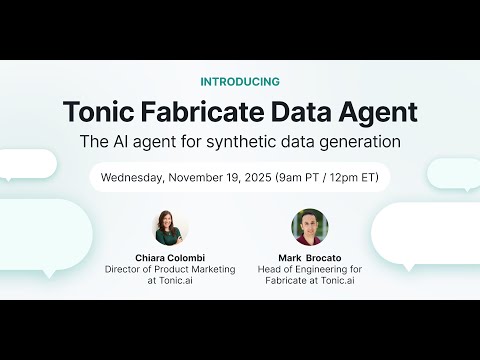
Fabricate is the most immediately approachable. A developer can describe a domain, ask the Data Agent for a relational dataset, refine the schema in conversation, validate the result, and export it into common database or file formats. It can generate logically connected data across tables, files, and APIs, build mock APIs from a specification, and turn a successful generation into a repeatable workflow. It also supports MCP, which means compatible coding clients can request synthetic data without forcing the developer to leave the tool where the work is happening. For a greenfield feature, a sales demo, an integration test, or a model-training experiment, that reduces the usual wait for a real dataset.
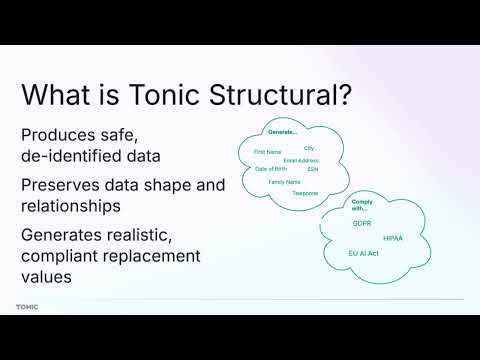
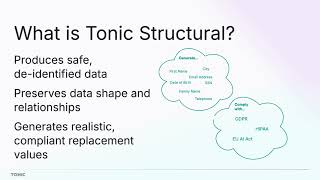
Structural addresses the more established and operationally difficult case. The organization already has production data, but copying it into development or QA creates privacy, security, and compliance risk. Structural connects to source systems, scans for sensitive columns, applies generators or masking rules, and writes protected output to a destination. Its central engineering value is consistency. If the same customer identifier appears in multiple tables or systems, transformations must preserve the relationships the application expects. Its subsetting engine is designed to follow dependencies and create coherent smaller datasets rather than a random bag of rows. That can make local debugging, staging refreshes, and performance tests faster while reducing the amount of production-derived material moving through lower environments.
Textual extends the same privacy problem beyond rows and columns. Names, addresses, clinical details, account numbers, and other identifiers are often embedded in support tickets, PDFs, chat transcripts, call recordings, and free-form notes. Simple regular expressions miss context; blunt redaction can destroy the meaning an AI or analytics workflow needs. Textual uses named entity recognition to identify sensitive entities, then supports redaction, reversible tokenization, or synthetic replacement. It can sit before an LLM prompt, inside a RAG ingestion pipeline, or in a batch preparation job for training and evaluation data. Tonic says Textual supports more than 50 languages and can be deployed as a hosted service or self-hosted for tighter control.
The Product Decision Is Really a Data-Origin Decision
A useful buying question is not simply whether the team wants synthetic data. Ask where the useful patterns currently live. If the team is inventing a new product or lacks representative source data, Fabricate is the natural starting point. If the value sits in a production database whose relationships and business rules need to survive, Structural is the core product. If the risk is concentrated in documents, conversations, or other unstructured content, Textual is the better fit. Larger programs may combine them: Structural for relational systems, Textual for attached notes and files, and Fabricate to fill rare scenarios that production does not contain.
This also prevents a common proof-of-concept mistake. Teams sometimes judge synthetic data by opening a few rows and asking whether they look human. A better test begins with the workflow that has been blocked. Can the generated dataset reproduce a troublesome account state? Does a test suite run without foreign-key failures? Can QA refresh an isolated environment without a ticket to the data team? Can a model be evaluated on sensitive conversational patterns without exposing the original people? The product earns its place when it removes a concrete dependency while preserving the signals that matter to the work.
Privacy Claims Need a Threat Model
Synthetic does not automatically mean anonymous, and masked does not automatically mean compliant. If a workflow models production distributions too closely, retains rare combinations, or leaves an overlooked identifier untouched, a privacy risk may remain. If deterministic transformations are used to keep values consistent across systems, the governance team needs to understand where the mapping occurs and who can reverse it. If an LLM helps generate or refine data, the team should know what prompts, samples, and metadata leave its environment and what the training opt-out actually covers. Tonic provides privacy scans, reports, audit features, DPAs, and enterprise agreement options, but those are controls inside a broader program rather than a substitute for one.
Before deployment, define the data classes in scope, the people who may access the output, the environments where it will travel, the re-identification threats that matter, and the evidence required by security or compliance reviewers. Healthcare teams may need a HIPAA de-identification pathway and expert determination. Financial teams may need PCI controls and proof that account or payment fields are consistently protected. Global teams may need regional processing and data-transfer answers. The correct configuration depends on this context, so a polished demo should never be treated as privacy validation.
Utility Deserves Equal Scrutiny
Privacy-safe data that no longer exercises the application is not a win. Teams should validate schema constraints, referential integrity, uniqueness rules, null behavior, ranges, correlations, time sequences, and the prevalence of critical states. They should also test what happens after the next production schema migration. Structural advertises schema change alerts and automated refreshes, which are useful, but ownership still matters: someone must decide whether a new column is sensitive, select or approve its transformation, and confirm that downstream tests remain meaningful.
For Fabricate, the equivalent risk is confident invention. A conversational agent can create a plausible schema and realistic values, but domain plausibility is not the same as correctness. The generated world may contain assumptions that conflict with the application's contracts or the organization's policies. Treat the first output as a candidate. Give the agent constraints, boundary conditions, forbidden combinations, expected distributions, and explicit failure cases. Then validate the result with automated checks. Fabricate includes a Validation Agent, but teams should still own their acceptance criteria and run independent tests where the consequences matter.
Textual needs two scorecards. Detection quality measures whether sensitive entities are found and correctly classified. Utility measures whether the transformed content still supports search, retrieval, training, or analysis. Over-redaction can make a document safe but nearly meaningless. Under-redaction preserves utility while leaking information. Build a labelled evaluation set from the actual kinds of content the organization handles, including abbreviations, misspellings, domain identifiers, multilingual examples, and awkward formatting. Measure false negatives separately from false positives because the costs are rarely equal.
Pricing Is a Portfolio, Not One Number
Tonic now publishes clear entry pricing for Fabricate. The Free plan is $0 per month and includes $5 in monthly credits. Plus is $29 per month with $25 in credits and metered charges for additional use. Fabricate Enterprise is custom priced and adds pooled usage, expanded export options, dedicated support, multiple workspaces, role-based access, SSO, and a self-hosted option. That makes Fabricate easy to sample, but usage depends on tokens and conversational turns, so a realistic test should include the complex schemas, revisions, and validation cycles the team expects to run.
Structural remains sales-led. Professional and Enterprise both use custom pricing, with annual cost determined by the plan and the amount of connected source data. Professional is positioned for up to 10 TB of source data, up to 10 users, and two source types in Tonic Cloud. Enterprise removes those limits, adds broader governance, and supports cloud or self-hosted deployment. Textual uses volume pricing based on words processed, with an enterprise option and custom annual allocations. Buyers should therefore model the full workflow: source volume, refresh frequency, number of environments, concurrency, generated output, unstructured word volume, implementation work, infrastructure, and support.
The cheapest comparison is rarely a home-grown masking script. A script looks inexpensive until schema drift, cross-table consistency, audit evidence, new databases, and operational ownership arrive. The fair comparison is the cost of keeping that system correct over time, plus the delay imposed on developers who wait for data. On the other hand, a team with one small database, modest privacy requirements, and stable transformations may find a focused internal process sufficient. Tonic becomes more compelling as sources multiply, regulations tighten, refreshes become frequent, and the cost of weak test data becomes visible in production defects or slowed AI work.
A Pilot That Can Survive the Demo
Choose one painful but bounded workflow. For Structural, select a database with real relationships and several sensitive data types, then define a target such as provisioning a useful QA subset every night. For Textual, choose one document or conversation pipeline and create a labelled evaluation set. For Fabricate, pick a feature whose development is waiting on data and write the acceptance tests before generation begins. Avoid starting with the organization's largest or most politically sensitive dataset. The pilot should be consequential enough to expose failure modes, but small enough that the team can understand every transformation.
Record baseline measures before touching the product: provisioning time, manual approvals, environment size, failing tests caused by stale or unrealistic data, sensitive fields discovered, and engineer hours spent preparing fixtures. During the pilot, track generation time, transformation coverage, validation failures, output utility, and the number of manual corrections. Ask developers and QA staff whether they can actually self-serve, not merely whether the interface feels pleasant. Ask security whether the reports and deployment model provide the evidence they need. Ask the platform team what will own schedules, credentials, logs, and recovery when a generation fails.
Then deliberately break the happy path. Add a sensitive column. Rename a field. Change a foreign key. Insert a rare state. Feed Textual a poorly scanned document or a multilingual transcript. Ask Fabricate for a contradictory rule and see how the planning and validation loop responds. A synthetic data platform becomes infrastructure only when the organization knows how it behaves under change. The best pilot output is not a perfect demo database. It is an operating model with named owners, automated checks, escalation paths, and a clear statement of residual risk.
Where Tonic Fits
Tonic.ai is strongest for engineering and AI organizations that need production-like data but cannot responsibly scatter production records across development, testing, demos, and model pipelines. Structural gives mature software teams a governed route from production patterns to refreshable lower environments. Textual tackles the fast-growing problem of sensitive information inside unstructured AI workflows. Fabricate gives individuals and teams a quicker way to create coherent data, mock services, and edge cases before real data exists. Together, they form a more complete platform than the old description of Tonic as a database masking tool.
It is less suitable for teams seeking a universal data governance suite, a general ETL platform, or a guarantee that generated data is legally anonymous without internal validation. It also demands serious implementation thinking when deployed across many sources. Connectors reduce plumbing, but they do not choose the right privacy policy, define acceptable utility loss, or own downstream test quality. Organizations that treat Tonic as a button will miss most of its value and underestimate its risk. Organizations that treat it as governed test and AI data infrastructure are much more likely to get the promised result: data that arrives when builders need it, resembles the systems they are building, and exposes far less of the people behind production records.
The WhatAI Verdict
Tonic.ai is an unusually coherent answer to a problem that is often split between security, data, QA, and AI teams. Its three-product structure now makes practical sense: generate from scratch with Fabricate, protect structured production data with Structural, and de-identify unstructured content with Textual. The free Fabricate tier creates a low-friction way to experience the product philosophy, while Structural and enterprise Textual remain considered infrastructure purchases. The right evaluation is not whether Tonic can produce convincing sample data. It is whether the platform can repeatedly deliver privacy-appropriate, technically useful datasets under the organization's real schemas, edge cases, controls, and rate of change. If it can, synthetic data stops being a workaround and becomes part of how software is safely shipped.
Tonic.ai helps development, QA, security, and AI teams create safer production-like data. Its portfolio covers data generation from scratch, structured production-data de-identification, coherent database subsetting, and sensitive-entity protection for text, documents, images, and audio.
Pricing, Products, and Test Data Fit
Fabricate offers free and $29 monthly plans plus enterprise pricing. Structural uses custom annual pricing based partly on connected source volume. Textual uses word-based usage pricing and custom enterprise plans. Product fit depends on whether the team needs to generate new data, protect structured data, or de-identify unstructured content.
Should Your Team Use Tonic.ai?
Tonic.ai is best for organizations that need repeatable, privacy-aware data for lower environments and AI pipelines without broadly copying raw production records. A serious pilot should measure both privacy protection and technical utility, including relationships, edge cases, schema changes, and downstream test quality.
About Tonic.ai
Tonic.ai is a synthetic data platform for software development, testing, and AI workflows. Tonic Fabricate generates relational databases, files, and mock APIs from prompts or connected schemas. Tonic Structural discovers and transforms sensitive structured production data while preserving relationships and enabling coherent subsets. Tonic Textual detects, redacts, tokenizes, or synthesizes sensitive entities in unstructured text, documents, images, and audio. Teams can use hosted cloud services, APIs and SDKs, or selected self-hosted deployment options, depending on product and plan.
Use Cases
Key Features
- ✓ Agentic generation of relational and unstructured synthetic data
- ✓ Sensitive data discovery for PII and PHI
- ✓ Consistent masking and synthesis across related fields
- ✓ Referentially intact database subsetting
- ✓ Named entity recognition for text and audio
- ✓ Mock API creation from API specifications
- ✓ Automated workflows, REST APIs, SDKs, and webhooks
- ✓ Cloud and selected self-hosted deployment options
- ✓ Privacy reports, audit trails, RBAC, and SSO on qualifying plans
Pricing
Fabricate Free
$0/month
- • $5 in monthly credits
- • Basic export options
- • Tonic Cloud deployment
- • Discord support
Fabricate Plus
$29/month
- • $25 in monthly credits
- • Metered additional usage
- • Discord and email support
- • Tonic Cloud deployment
Fabricate Enterprise
Custom
- • Custom and pooled usage
- • Expanded exports
- • Multiple workspaces and RBAC
- • SSO and self-hosted option
Structural Professional
Custom
- • Up to 10 TB source data
- • Up to 10 users
- • Two source types
- • Tonic Cloud deployment
Structural Enterprise
Custom
- • Unlimited source data and users
- • All supported source types
- • RBAC and SSO/SAML
- • Cloud or self-hosted deployment
Textual Pay-as-you-go
Volume based
- • Flat rate per 1,000 words
- • Unlimited words scanned
- • Unlimited users
- • Custom detection models
Textual Enterprise
Custom
- • Cloud or self-hosted deployment
- • Dedicated account manager
- • Implementation support
- • Annual word allocations available
Pricing varies by plan and region — see current pricing.
Plan features change — last updated: 2026-08-24.
Details
Tags
Tonic.ai Community Discussions
Explore community discussions. Ask and answer questions on Tonic.ai to grow and learn together.
Tonic.ai Showcase

Tonic.ai — Frequently Asked Questions
What is Tonic.ai?
Tonic.ai is a synthetic data platform for software development, testing, and AI. Fabricate generates data, Structural de-identifies structured production data, and Textual protects sensitive information in unstructured content.
Is Tonic.ai free?
Tonic Fabricate has a free plan with $5 in monthly credits. Fabricate Plus costs $29 per month. Structural and enterprise plans use custom pricing, while Textual uses volume-based pricing.
Does Tonic.ai copy production data?
Structural connects to production sources and transforms sensitive values into protected output while preserving useful relationships. Deployment and data movement depend on the chosen architecture, so teams should review the exact flow during procurement.
Can Tonic.ai be self-hosted?
Selected enterprise plans support self-hosting. Structural Enterprise and Fabricate Enterprise list self-hosted options, and Textual can run through cloud, marketplaces, or self-hosted deployments including Kubernetes or Docker.
What databases does Tonic Structural support?
Official pricing materials list PostgreSQL, MySQL, MariaDB, SQL Server, MongoDB, DocumentDB, Snowflake, BigQuery, Redshift, Databricks, Salesforce, Spark SDK, flat files, Db2, and enterprise-only Oracle.
Is synthetic data automatically anonymous?
No. Privacy depends on source data, transformations, configuration, access controls, rare-value risk, and the intended use. Teams should validate protection and utility against a documented threat model.
Can Tonic protect data before it reaches an LLM?
Yes. Tonic Textual is designed to detect and transform sensitive entities in text and other unstructured formats before prompts, RAG ingestion, training, or evaluation workflows.
Sources & References
Try Tonic.ai
Visit the official website to get started with Tonic.ai today.
Visit Tonic.ai →