Copy.ai Has Outgrown Its Name
A copywriter became a GTM operating layer
By WhatAI Editorial ·
Copy.ai has outgrown its own name
There is still a perfectly usable AI copywriter inside Copy.ai. Open Chat, choose a model, give it a brief and ask for an email, landing page, product description or campaign idea. That familiar experience explains the name and much of the product's early popularity. It no longer explains the company Copy.ai is trying to become. The current platform is built around go-to-market workflows: prospect research, lead processing, account enrichment, content production, localization, deal analysis and the movement of information between the systems used by marketing, sales and operations teams.
That shift matters because a buyer searching for an inexpensive writing assistant can now land on the same pricing page as a revenue organization considering a $12,000 annual workflow plan. Both are legitimate Copy.ai customers, but they are buying different things. One wants a flexible chat subscription. The other wants to encode a repeatable process, connect business data, let AI make bounded decisions and run the process many times. A useful review therefore has to separate the chat product from the automation platform before it can judge either one fairly.
The name points backward, the platform points forward
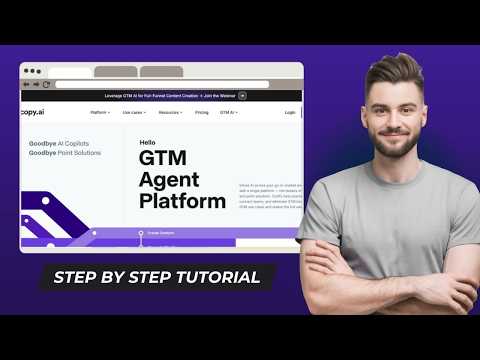
Copy.ai describes itself as a GTM AI platform rather than a copy generator. GTM means go to market, the connected work of finding customers, producing the material that explains an offer, helping sales teams engage accounts and managing the information that supports revenue decisions. Copy.ai's navigation now groups use cases across sales, marketing and operations. Its product vocabulary includes Workflows, Actions, Tables, Infobase, Brand Voice and Copy Agents. These parts are intended to turn a company's playbooks and data into repeatable work rather than simply generate another isolated draft.
The distinction is easiest to see in a lead-processing example. A writing tool can draft an outreach email after a person supplies the relevant facts. A GTM workflow can receive a new lead, enrich the account, research the contact, apply qualification rules, create a personalized message, update the CRM and send an uncertain case to a person. Copy.ai says its agents make goal-oriented micro-decisions inside configurable constraints, while workflows chain actions such as generation, research and web scraping. The value is not the prose alone. It is the complete movement from trigger to approved outcome.
Copy.ai still deserves its Marketing category because content, messaging and brand consistency remain central to the product. Content Agent Studio is a clear example. A team supplies three examples of strong work, then creates purpose-built agents for formats such as blogs, emails, case studies and sales collateral. The promise is to carry voice and structure across repeated production without asking every user to rebuild a complicated prompt. Sales and operations are important adjacent surfaces, but marketing is the most coherent primary home for discovery in WhatAI.
One product, two very different buying decisions
The Chat plan is the accessible end of Copy.ai. It is listed at $29 per month, or $24 per month when billed annually, and includes five seats, unlimited words in Chat, unlimited chat projects and access to models from OpenAI, Anthropic and Google. This plan makes sense for a small group that wants a shared environment for ad hoc drafting, analysis and idea development. The phrase unlimited words applies to Chat. It should not be read as unlimited workflow automation, unlimited research or an unrestricted enterprise content engine.
The next public tier is Growth at $1,000 per month, billed as $12,000 annually. It lists 75 seats and 20,000 workflow credits per month. Expansion is $2,000 per month billed annually, with 150 seats and 45,000 workflow credits. Scale is $3,000 per month billed annually, with 200 seats and 75,000 workflow credits. Enterprise is custom and advertises guided implementation, API access, bulk workflow runs, more than 20 technology integrations, unlimited customizable workflows, a designated account and support team, and enterprise security protocols.
This creates an unusually large step between casual use and operational use. The jump is not necessarily unreasonable: a deployed workflow platform with many seats, integrations and implementation support is a different product from a writing subscription. It does mean a growing team should not assume there is a smooth $100 or $250 bridge from Chat into serious automation. The older Advanced or Agents pricing still appears in historical articles and third-party reviews, but it is not part of the current official pricing table. Budget from the live page and confirm any sales quote in writing.
Workflow credits are the number to understand
Copy.ai's platform economics depend on workflow credits, yet a plan allowance alone does not reveal the cost of a completed business process. A single run can include several actions, model calls, research steps and data operations. Different actions may consume usage differently. Before choosing a tier, map one representative workflow from its trigger to its final record and ask Copy.ai to estimate credits for a normal run, a complex run, a failed run and a retry. Multiply those figures by real monthly volume, then leave room for testing and process changes.
This is especially important for content teams. Unlimited Chat words can sound like unlimited content production, but a governed content operation may use Content Agent Studio, reference examples, research, brand data, review stages and integrations. Those are not the same as typing into Chat. If a team plans to create 500 localized product pages or personalized account assets, it should measure the entire production path, including human review and rejected outputs, rather than divide the subscription by the number of final documents.
The best first workflow is boring on purpose
Copy.ai's site offers ambitious use cases such as prospecting, inbound lead processing, account-based marketing, deal coaching and forecasting. The strongest first deployment is usually narrower. Choose a process people already perform, where the inputs are known and the outcome can be checked. Updating missing CRM fields, preparing a first draft from an approved brief, translating a defined asset or assembling a pre-call account summary are better pilots than automate our marketing. A bounded job reveals whether the platform can carry the real rules of the business.
Begin with a small set of historical cases. Document what a good outcome looks like, where the source facts live and which exceptions force a person to stop and think. Build the workflow in shadow mode if possible, producing recommendations without committing changes. Compare its results with completed human work. The objective is not to prove that a model can produce fluent language. It is to learn whether the workflow uses the right evidence, follows the correct sequence and recognizes when it should not act.
Only then should the team enable write actions or external delivery. Restrict the fields, systems and audience available to the workflow. Require approval for high-risk changes and retain a sample of ordinary cases for quality review. A content draft can be edited; an incorrect CRM update can distort reports, and an unreviewed outbound message can reach a real customer. The closer the workflow gets to publishing, sending or changing a source of truth, the more explicit its permissions and rollback path should become.
Integrations are broad, but depth still matters
Copy.ai advertises more than 2,000 integrations and displays logos including Salesforce, HubSpot, Gong, Zapier, Outreach and Salesloft. Its Enterprise description separately mentions more than 20 technology integrations plus API access. Those numbers likely describe different connection paths rather than 2,000 equally deep native connectors. A Zapier-supported action, a dedicated enterprise integration and a custom API connection can all connect two systems, but they differ in authentication, available objects, write support, rate limits, maintenance and procurement effort.
A serious evaluation should start with the exact data path. Ask whether Copy.ai can read the required object, write the required field and preserve the identifiers needed for auditing. Confirm how it handles duplicates, stale records, permission changes and partial failures. If a workflow relies on a CRM, conversation-intelligence system and data provider, test the combined path at realistic volume. Integration logos are useful orientation; they are not an implementation specification.
The intelligence layer is where the product becomes interesting
Brand Voice and Infobase address two common weaknesses in general AI chat: inconsistency and missing company context. Tables provide a structured place to work with data, while Actions are the building blocks used inside workflows. Copy Agents add bounded decision-making for tasks that cannot be expressed as a rigid sequence. Copy.ai also promotes an LLM-agnostic approach, with Chat access to OpenAI, Anthropic and Gemini models. This can reduce dependence on one model vendor and lets a workflow use different model strengths, although the buyer should still ask which model handles each sensitive step and what controls are available.
Content Agent Studio turns this architecture into a marketer-friendly product. Teaching an agent from a small set of approved examples is more intuitive than writing a large system prompt. It also moves the quality question upstream. Three weak examples will codify weak habits, and three exceptional but unrepresentative examples may create an output style that does not fit everyday briefs. Teams should curate examples, define non-negotiable facts and claims, and test the agent across varied formats before treating its output as reliably on brand.
Human editing is not a failure condition
Copy.ai's marketing understandably emphasizes scale, but finished marketing work still carries judgment, accountability and taste. A useful agent can remove the blank page, assemble source material, preserve structure and produce a credible first draft without being the final publisher. The real measure is whether editors spend their time improving an argument and sharpening a message, rather than correcting invented facts, generic claims or broken formatting. A workflow that creates more review debt than it removes has not succeeded, even if its raw output volume is impressive.
This is why teams should measure acceptance rate and edit distance, not just documents produced. Track how often a draft is usable, which sections are routinely rewritten, how many factual corrections are required and whether the final piece sounds recognizably like the organization. For sales workflows, measure approved personalization, reply quality, data accuracy and exception rates. For operations, measure backlog, cycle time and the number of records requiring repair. Copy.ai can support several departments, but each needs its own definition of quality.
Security deserves workflow-level review
Copy.ai's security page states that individual customer data is not used to train its models, prompts are not shared with other customers and data is not sold. It offers access to a SOC 2 report through its trust center and promotes enterprise security infrastructure. Those are helpful vendor commitments. They do not remove the need to inspect the current agreement, subprocessors, retention rules, model-provider terms, regional processing and the controls attached to the chosen plan.
The risk grows with the usefulness of the workflow. A chat used for public marketing ideas has a different profile from an agent reading CRM notes, call transcripts and unreleased product plans. Classify the data before connecting it. Use least-privilege credentials, separate test and production environments, define who can edit a workflow, and log the actions that affect customers or systems of record. Security is not a badge added after the agent works; it is part of the workflow design.
Where Copy.ai fits now
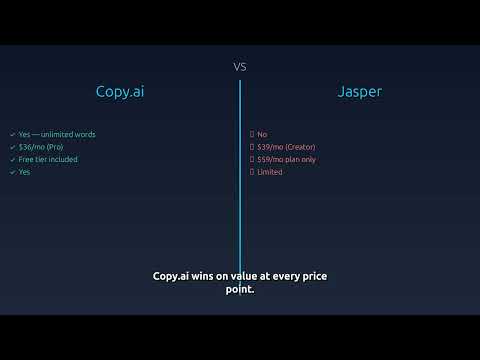
Jasper remains a natural comparison for brand-governed enterprise marketing content. Anyword is more focused on marketing copy and performance-oriented messaging. Writesonic spans writing, SEO and generative search visibility with a more direct content-tool identity. Copy.ai differentiates itself by pushing beyond the document into cross-functional GTM workflows. It is the stronger fit when content generation is one stage inside a repeatable revenue process, and a weaker fit when an individual simply wants the cheapest or most specialized writing interface.
It also overlaps with broader automation platforms, but its center of gravity is different. A general automation tool is often best when logic is deterministic and connector breadth is the main requirement. Copy.ai is more compelling when the process contains research, language, brand knowledge and bounded judgment. The tradeoff is commitment: teams need enough recurring volume and organizational ownership to justify workflow design, credit planning, integration work and governance.
The WhatAI verdict
Copy.ai should no longer be evaluated as a clever way to produce a paragraph. The $29 Chat plan can still serve that need for a small team, and the free writing tools remain a low-friction way to try individual generators. The larger story is a marketing-centered GTM platform that tries to encode how work moves between content, data, sales and operations. Its Workflows, Actions, Tables, Infobase, Brand Voice and agents form a credible architecture for that ambition.
The buying decision should begin with scope, not a demo. Decide whether you need Chat or workflow automation. Choose one measurable process, verify every integration, model its credit use and run it against real historical cases. Keep human review where the consequences justify it, and expand only when the workflow reduces total work rather than merely producing more output. Copy.ai has outgrown its name, but buyers still need to prove that the platform can grow into their operating reality.
Copy.ai has evolved from an AI copywriter into a go-to-market automation platform. It combines multi-model Chat with workflows, agents, business data, brand knowledge, and integrations for marketing, sales, and operations teams.
Copy.ai Pricing, Workflows, and Best Use Cases
Copy.ai Chat costs $29 per month or $24 with annual billing. Workflow plans begin at $1,000 per month billed annually and scale through Growth, Expansion, Scale, and custom Enterprise options with increasing seats and workflow credits.
Is Copy.ai Still a Writing Tool?
Yes, Copy.ai still generates marketing content through Chat and free tools. Its main platform now goes further, using workflows and constrained agents to connect research, content, data, and GTM actions across repeatable business processes.
About Copy.ai
Copy.ai is a go-to-market AI platform for marketing, sales, and operations teams. It combines multi-model Chat with Workflows, Actions, Tables, Infobase, Brand Voice, and constrained Copy Agents to automate research, content production, lead processing, CRM enrichment, localization, and other repeatable revenue processes. The product still supports ad hoc AI writing, but its current enterprise direction is workflow orchestration across connected data and business systems. Teams can codify playbooks in a no-code builder, add human review and governance, and scale execution with workflow-credit plans.
Use Cases
Key Features
- ✓ Multi-model AI Chat for team use
- ✓ No-code go-to-market workflow builder
- ✓ Constrained agents for bounded decisions
- ✓ Content Agent Studio trained from examples
- ✓ Brand Voice and Infobase knowledge controls
- ✓ Tables for structured business data
- ✓ Actions for research, generation, and data work
- ✓ API access and bulk workflow runs
- ✓ Sales, marketing, and operations use cases
Pricing
Chat
$29/mo or $24/mo annual
- • 5 seats
- • Unlimited words in Chat
- • Unlimited chat projects
- • OpenAI, Anthropic, and Gemini models
Growth
$1,000/mo billed annually
- • 75 seats
- • Unlimited words in Chat
- • 20,000 workflow credits per month
Expansion
$2,000/mo billed annually
- • 150 seats
- • Unlimited words in Chat
- • 45,000 workflow credits per month
Scale
$3,000/mo billed annually
- • 200 seats
- • Unlimited words in Chat
- • 75,000 workflow credits per month
Enterprise
Custom
- • Guided implementation
- • API and bulk workflow runs
- • 20+ technology integrations
- • Unlimited customizable workflows
- • Enterprise support and security
Pricing varies by plan and region — see current pricing.
Plan features change — last updated: 2026-08-24.
Details
Tags
Copy.ai Community Discussions
Explore community discussions. Ask and answer questions on Copy.ai to grow and learn together.


Copy.ai Showcase


Copy.ai — Frequently Asked Questions
What is Copy.ai now?
Copy.ai is a go-to-market AI platform for marketing, sales, and operations. It includes multi-model Chat plus workflows, agents, business-data tables, brand knowledge, and integrations for automating repeatable revenue processes.
Is Copy.ai still an AI writing tool?
Yes. Chat and free generators still support copywriting and content tasks. The broader product now emphasizes end-to-end GTM workflows, content agents, research, lead processing, enrichment, and operational automation.
How much does Copy.ai cost?
Chat is $29 per month or $24 per month with annual billing. Growth is $1,000 per month billed annually, Expansion is $2,000, Scale is $3,000, and Enterprise uses custom pricing.
Does Copy.ai have a free plan?
The current official pricing table does not list a permanent free platform plan. Copy.ai does provide separate free writing generators, but these should not be confused with full Chat or workflow-plan access.
What are Copy.ai workflow credits?
Workflow credits are the usage allowance for automated workflows. The public plan table lists monthly credit totals, but teams should confirm how each action, model call, data operation, failure, and retry is counted for their process.
What is Content Agent Studio?
Content Agent Studio lets marketers create purpose-built content agents from three approved examples. The agents learn the intended voice and structure for formats such as blogs, emails, case studies, and sales collateral.
Which models does Copy.ai support?
The Chat plan advertises access to models from OpenAI, Anthropic, and Google. Copy.ai promotes an LLM-agnostic approach so teams can use different model strengths across tasks.
Which tools integrate with Copy.ai?
Copy.ai advertises more than 2,000 integration paths and shows Salesforce, HubSpot, Gong, Zapier, Outreach, and Salesloft. Enterprise separately lists 20+ technology integrations plus API access, so verify the exact connection type and actions required.
Does Copy.ai train on customer data?
Copy.ai states that it does not train its models on individual customer data, share prompts with other customers, or sell customer data. Enterprise buyers should still review the current agreement, trust center, subprocessors, retention, and model-provider terms.
Sources & References
Try Copy.ai
Visit the official website to get started with Copy.ai today.
Visit Copy.ai →