FedEx and Dexterity Move Autonomous Trailer Loading Beyond Pilot
The Hagerstown expansion moves Mech beyond its earlier pilot while Foresight, Instinct, and faster perception define the production stack.
By WhatAI Editorial Team ·
FedEx and Dexterity have moved autonomous trailer loading beyond the earlier pilot location and into a larger operational test at the FedEx Hagerstown Hub in Maryland. The July 30 announcement matters because trailer loading is one of the hardest warehouse workflows to automate, and because the new site is intended to test not just robotic picking and placement but integration with destination planning, trailer assignment, maintenance, workforce processes, and the broader rhythm of a high-volume hub.
According to the [joint deployment update](https://dexterity.ai/blog/fedex-hagerstown-physical-ai-deployment), the expanded collaboration follows multiple years of development, testing, and operational validation. Dexterity says its Mech systems at Hagerstown are powered by the Foresight world model and designed to load trailers while optimizing package placement for space, stability, speed, and operating conditions. The release does not disclose the number of systems, go-live schedule, measured throughput, packing density, uptime, economics, or planned network expansion. Buyers should treat it as a meaningful scale milestone, not a completed performance report.
That distinction is important. Moving beyond a pilot shows that FedEx and Dexterity have enough confidence to evaluate the technology at a significantly larger operating scale. It does not prove that the system is ready for every parcel hub or trailer type. A hub-level deployment has to survive variable package flow, changing destinations, dock deadlines, equipment faults, maintenance windows, worker handoffs, conveyor interruptions, damaged parcels, and the operational consequences of a load that is stable for the robot but inconvenient to unload.
### Why trailer loading is a Physical AI problem
Traditional industrial robotics works best when objects, positions, tooling, and sequences are controlled. Parcel loading violates most of those assumptions. Packages arrive in changing sizes, weights, shapes, materials, and conditions. The next box may be unknown until it reaches the robot. A strong placement must be reachable by the arm, stable under its own weight, safe for surrounding packages, dense enough to use trailer volume well, compatible with the current wall, and fast enough to keep up with the dock.
The scene changes after every pick. A box can shift when a neighbouring package is pressed into place. A surface hidden from cameras becomes visible only after an object moves. A narrow gap may be slightly different from the geometric estimate. Weight, friction, crushed corners, loose flaps, film, labels, and contents affect what happens during contact. A fixed coordinate program cannot enumerate every combination.
Dexterity's answer is [Foresight](https://dexterity.ai/blog/foresight), a world model that integrates vision, depth, robot body state, force feedback, and the outcomes of prior physical interactions. It maintains an explicit model of the current scene, predicts what candidate actions may do, tracks uncertainty and physics constraints, and updates its state after execution. Dexterity says Foresight has been trained with experience from more than 100 million autonomous production actions. That is a vendor-reported aggregate, so a buyer should still ask which actions, applications, robots, sites, and acceptance criteria are represented.
For packing, Foresight evaluates placement options in three spatial dimensions plus time. Time matters because Mech has two arms. A placement that looks good geometrically may block the second arm or delay the next action. The system must jointly consider density, stability, reachability, collision risk, and parallel execution. Dexterity reports that the packing agent usually makes a placement decision in under 400 milliseconds. The practical metric is not decision latency alone. It is completed, stable, damage-free packages per hour through the full dock process.
### Mech is not a general-purpose humanoid
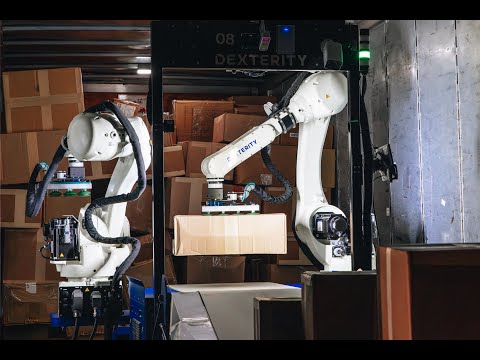
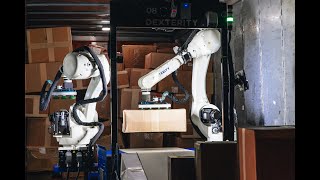
Dexterity calls Mech an industrial superhumanoid, but the machine is not designed to imitate a person in every respect. The [platform page](https://dexterity.ai/platform) describes a purpose-built logistics and manufacturing system with two industrial arms, industrial force control, a sense of touch, and an AI-capable mobile base. The compact form is intended to work inside trailers, where a conventional fixed cell or human-shaped robot may waste space or lack the reach and parallelism required.
The dual-arm design creates important advantages and engineering demands. One arm can work while the other prepares or executes a separate action, improving throughput when the packing plan allows safe parallelism. The system must also prevent the arms from colliding with each other, the trailer, the package flow, and the load. Dexterity's Actualization Agent allocates actions across the arms, while the Trajectory Agent plans collision-free motion and the Motion Agent abstracts the underlying robot structure.
Dexterity says its platform orchestrates more than 68 specialized agents. These include perception, packing, motion, force, trajectory, task allocation, and safety functions. The value of this architecture is that each skill can be specialized and interpreted rather than relying on one opaque model to control everything. The cost is system complexity. A deployment needs monitoring, version control, validation, fault isolation, compute, network and edge infrastructure, calibration, logging, and a clear method for showing which agent made or constrained a decision.
The Mech hardware is also an industrial maintenance asset, not just an AI endpoint. Dexterity says the arms are manufactured by Kawasaki and cites a mean time between failures above ten years for the arms, together with operating ranges for temperature, altitude, and humidity. Buyers should request the exact reliability definition and complete system figures. Arm MTBF does not equal cell availability. Grippers, sensors, computers, conveyors, cables, mobile bases, safety devices, and upstream equipment may fail on different schedules.
### Instinct adds touch to the world model
Vision can estimate where a package is, but contact reveals what the scene actually feels like. Dexterity introduced [Instinct](https://dexterity.ai/blog/instinct) in April as a tactile skill for force-guided manipulation. In trailer packing, Instinct can guide a package into a constrained gap, reacting to contact rather than relying only on the pre-contact geometric model.
The relationship between Foresight and Instinct is two-way. Foresight decides when tactile manipulation is appropriate based on the scene and expected feasibility. As the robot presses or slides the package, force measurements show whether the gap is narrower, angled, unstable, or otherwise different from the visual estimate. That contact evidence flows back into Foresight so the world model can update. Dexterity says Instinct is triggered around two thousand times during a typical production shift.
This is a useful capability, but it needs bounded testing. A force-guided robot must know when to continue, slow, retry, roll back, or reject the placement. Buyers should test fragile cartons, crushed edges, liquid contents, soft parcels, unstable walls, slippery film, hidden protrusions, irregular shapes, and genuinely impossible gaps. Acceptance criteria should include maximum force, contact duration, package damage, wall movement, retries, cycle time, intervention, and safe failure.
Dexterity reports Instinct control rates up to two kilohertz and response below two milliseconds. These engineering metrics support rapid reaction, but they do not by themselves prove shipment quality or safe site operation. The complete safety case includes sensors, control architecture, certified devices, guarding or separation, emergency stops, conveyor interfaces, lockout and tagout, worker training, maintenance, inspections, and incident response.
### NVIDIA acceleration changed the perception loop
In March, Dexterity [reported a 17-fold acceleration of Foresight's visual perception pipeline](https://dexterity.ai/blog/nvidia-acceleration). The company said perception latency dropped from 1,508 milliseconds to 90 milliseconds through TensorRT-optimized inference, GPU-parallel geometric reasoning, and custom physics kernels. That brought the broader sense, think, and act loop within the cadence required for real-time dual-arm production work.
This update helps explain how the company can claim both careful physical reasoning and industrial speed. Before optimization, perception took longer than the total decision budget, so the system relied more heavily on predictive pipelining and sometimes used a slightly older world state. Faster perception allows planning to begin with fresher information and can reduce placement errors when the scene changes quickly.
A buyer should verify the exact compute configuration included in a proposal. Performance can depend on GPU model, thermal design, server redundancy, software version, cameras, network, and the number of concurrent robots or cells. Ask where inference runs, what happens if an edge server fails, how updates are deployed, how long the system can operate in a degraded mode, and how performance is monitored after a model or driver change.
### Dexterity publishes unusually detailed packing evaluations
Dexterity's [Foresight evaluation article](https://dexterity.ai/blog/foresight-evals) gives more methodological detail than most robotics marketing. It describes packing density, parallelism, stability, tilt, fissures, retries, perception noise, and evaluations across several package distributions. It also reports more than 400 picks per hour across two robot arms in a production context.
The definitions are valuable because they show that one number cannot represent a packing system. High density can conflict with arm reach or parallelism. A stable simulation wall may still contain gaps that affect trailer use. A fast sequence may create unloading difficulty or damage. Production constraints can reduce theoretical packing density, while a less dense wall might improve cycle time or reliability.
Prospective customers should adopt this multi-metric approach but use their own data. Provide real package distributions, including damage, labels, weight uncertainty, soft goods, envelopes, unusual shapes, and arrival sequences. Include real trailers, dock slopes, lighting, temperatures, conveyor rates, destination rules, and outbound quality expectations. Then measure density, wall stability, throughput, package damage, retries, interventions, robot utilization, downtime, trailer turnaround, and unload performance.
The acceptance test should include uncertainty and failure. Block the feed, delay destination assignments, remove a trailer, introduce an unreadable package, stop one arm, create a sensor fault, and require safe restart. Verify that the system preserves package tracking and does not create an unsafe or unrecoverable wall. A robot that performs well only on the normal path is not ready for a high-volume parcel hub.
### What the FedEx expansion means for buyers
The Hagerstown project is strategically important because it extends evaluation from a loading cell to hub operations. The release explicitly mentions destination planning, trailer assignment, maintenance, and workforce processes. These are often where technically capable automation fails to deliver system-level value. A loader may be fast, but it cannot work if the correct trailer is late, the package stream is imbalanced, a wall must be reopened, maintenance response is slow, or dock staff do not trust the exception process.
For FedEx, tens of thousands of trailers are loaded across the United States each day, so repeatability and network standardization matter. A successful Hagerstown deployment could inform future sites, but Dexterity and FedEx have not committed publicly in this release to a specific fleet or network schedule. The next evidence to watch is measured hub performance, system count, uptime, safety, worker experience, trailer quality, and whether the operating model transfers to different package mixes and building designs.
For other buyers, request references at the same maturity stage. Ask which deployments are pilots, operational validation, expanded production, or steady state. Confirm the number of robots, shifts, hours, package types, interventions, support staff, and connected docks. Marketing language such as full shifts or production actions is useful context, but procurement needs denominators and definitions.
### Pricing and commercial diligence
Dexterity does not publish a price list. The original record correctly marked pricing as custom, but it should not imply a generally available Foresight API tier. The 2026 API Challenge was a time-limited student and research competition and has concluded. Commercial platform access, supported skills, approved hardware, licensing, and developer support require direct confirmation.
A total-cost proposal should cover Mech systems, arms, grippers, mobile bases, sensors, edge compute, conveyors or feed changes, electrical and network work, safety controls, installation, integration, validation, training, maintenance, spare parts, support, remote access, software updates, data rights, performance commitments, expansion, and removal. Compare those costs against the complete manual dock process, including injuries, turnover, training, overtime, schedule variability, trailer utilization, damage, and downstream unload impacts.
The latest FedEx expansion is meaningful because it tests whether Dexterity's combination of world modelling, dual-arm robotics, touch, and operational integration can move from a validated pilot into a larger hub. The 2026 engineering releases provide a clearer account of how the system reasons and how Dexterity measures it. The remaining buyer task is rigorous site proof. Use real parcel distributions, real trailers, real dock constraints, failure testing, a formal safety case, and contractually defined outcomes. If Mech can sustain those conditions, autonomous trailer loading becomes an operating system, not a robotics demonstration.
Dexterity is an enterprise Physical AI platform for complex industrial manipulation. It combines a physically grounded world model, interpretable skill agents, dual-arm coordination, collision-free motion, force control, touch, safety telemetry, and purpose-built robot hardware.
How Foresight and Mech Automate Complex Logistics Work
The Mech system is designed for trailer loading and other demanding logistics applications. Foresight reasons about space, time, stability, reachability, and physical outcomes, while Instinct uses contact forces to guide placements when vision alone cannot resolve the real geometry.
Who Should Evaluate Dexterity?
Dexterity is best evaluated with real package and trailer distributions, end-to-end dock metrics, safety and maintenance planning, integration tests, exception handling, density and stability criteria, and a complete enterprise proposal rather than isolated robot demonstrations.
About Dexterity
Dexterity builds enterprise Physical AI systems for complex industrial manipulation. Its Foresight world model combines vision, depth, robot state, force feedback, and physical outcomes to predict and plan actions. Specialized agents handle packing, hardware-agnostic motion, dual-arm allocation, collision-free trajectories, and six-axis force control. Instinct adds tactile manipulation, while the Mech industrial robot provides two arms on a mobile base for demanding logistics work. Production applications include trailer loading and unloading, palletizing, depalletizing, aircraft loading and unloading, and singulation.
Use Cases
Key Features
- ✓ Foresight physically grounded world model
- ✓ Predictive action branching
- ✓ Sub-400-millisecond placement decisions
- ✓ Packing density and stability optimization
- ✓ Hardware-agnostic Motion Agent
- ✓ Dual-arm Actualization Agent
- ✓ Collision-free Trajectory Agent
- ✓ Six-axis Force Control Agent
- ✓ Instinct tactile manipulation
- ✓ IRIS hardware abstraction layer
- ✓ Real-time safety and telemetry
- ✓ Dual-armed Mech industrial robot
- ✓ Autonomous trailer loading
- ✓ Trailer unloading and singulation
- ✓ Palletizing and depalletizing
Pricing
Mech Deployment
Custom quote
- • Dual-arm industrial robotics
- • Foresight and skill-agent platform
- • Application engineering and support
Application Expansion
Custom quote
- • Additional cells, docks, or systems
- • Workflow and integration expansion
- • Performance and support services
Platform Access
Contact sales
- • Developer scope subject to approval
- • Supported skills and hardware
- • Custom licensing and support
Pricing varies by plan and region — see current pricing.
Plan features change — last updated: 2026-08-16.
Details
Tags
Dexterity Community Discussions
Explore community discussions. Ask and answer questions on Dexterity to grow and learn together.

Dexterity Showcase
Dexterity — Frequently Asked Questions
What does Dexterity automate?
Dexterity markets its Physical AI platform for trailer loading, trailer unloading, palletizing, depalletizing, aircraft loading and unloading, and singulation. Its best-known deployment is autonomous parcel trailer loading with FedEx.
What is Foresight?
Foresight is Dexterity's world model. It combines multimodal sensor data, robot state, and outcomes of physical interactions to maintain a physically grounded scene, predict candidate actions, track uncertainty, and support interpretable planning and execution.
What is Mech?
Mech is Dexterity's dual-armed industrial robot for logistics and manufacturing. It combines two industrial arms, force control, touch, an AI-capable mobile base, edge computing, sensors, and the Dexterity agent platform in a form designed to work inside trailers.
How much does Dexterity cost?
Dexterity does not publish standard pricing. Deployments are custom enterprise projects whose cost depends on application, robots, conveyors, dock or cell design, integrations, compute, safety, installation, support, throughput, and commercial terms.
Can Dexterity handle random packages?
Handling variable packages is a core product goal, but buyers should not assume unlimited coverage. Performance depends on size, weight, rigidity, damage, labels, surface, friction, arrival sequence, presentation, conveyor flow, grasp access, and trailer conditions.
Is the Foresight API publicly available?
Dexterity ran a limited 2026 Foresight API Challenge for students and researchers, and that challenge has concluded. Prospective commercial developers should confirm current platform access, documentation, licensing, scope, and support directly with Dexterity.
Sources & References
Try Dexterity
Visit the official website to get started with Dexterity today.
Visit Dexterity →