Robust.AI Plans 24-Robot Carter Rollout Across Two O'Neill Logistics Sites
A 24-robot O'Neill rollout, performance-backed ShipLab pilot, and Gen 3 perception update sharpen Carter's 2026 case.
By WhatAI Editorial Team ·
Robust.AI has moved Carter's 2026 story from general warehouse flexibility to a specific multi-site deployment: 24 collaborative mobile robots are planned for two O'Neill Logistics distribution centers. The July 28 agreement covers O'Neill facilities in Monroe, New Jersey, and Savannah, Georgia, with go-live planned for the fourth quarter of 2026. It is the company's newest announced customer project and a useful test of Carter's promise that one software-defined robot fleet can support several fulfillment workflows without fixed conveyor investment.
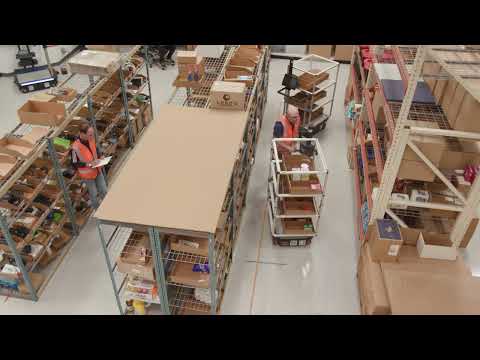
The [O'Neill announcement](https://www.robust.ai/oneill-logistics-deployment) says Carter will support retail and direct-to-consumer fulfillment in Monroe and omnichannel order fulfillment at O'Neill's one-million-square-foot Savannah campus. Robust.AI describes the work as reducing repetitive material handling and unproductive walking. O'Neill specifically highlighted system-directed picking, light-directed putting, and the ability to run a lean fleet. Those details make this more informative than a generic fleet order because they show how the robots are expected to interact with warehouse associates and order data.
There is still an important distinction between an announced deployment and a proven result. The 24 robots are planned to go live in Q4, so the project did not yet have published steady-state performance as of this update. Buyers should read the news as evidence of commercial adoption and multi-site intent, not as a completed case study. The questions that matter next are how quickly each building ramps, which workflows are live first, what integrations are required, how many associates work with the fleet, and whether measured productivity survives peak conditions.
### Why the O'Neill project matters
O'Neill is a third-party logistics provider with retail, ecommerce, consumer goods, food and beverage, apparel, and sporting-goods customers. A 3PL environment is a demanding test for flexible automation because customer profiles, packaging, order shapes, service levels, and seasonality can change faster than they do in a single-purpose warehouse. Fixed automation can work brilliantly when flow is stable, but a provider serving several brands may need to reconfigure processes, storage, labor, and capacity when accounts change.
Carter's proposition is that a common robot platform can switch among fulfillment picking, point-to-point transport, and mobile sortation through software and configuration. For O'Neill, that could mean using one fleet for directed picking during one part of the operation, moving totes to processing stations elsewhere, and supporting light-directed putting or sortation without buying different machines for each task. The commercial value depends on whether that switching remains simple in daily operations. A multi-function robot is only more flexible if the dispatch logic, shelving, training, reporting, and support model can change with it.
The deployment also spans two facilities. That creates an opportunity to standardize robot procedures, integration patterns, safety rules, training, and performance reporting across locations. It also exposes differences that a single-site pilot can hide. Network quality, aisle geometry, congestion, SKU profiles, management practices, and customer commitments may vary. A strong multi-site rollout needs a common operating standard plus enough local configuration to fit each building.
For buyers, the O'Neill announcement suggests a practical diligence request: ask Robust.AI to demonstrate not only an individual robot but also the control model for a lean fleet serving several workflows. The demo should show task prioritization, traffic handling, charging, shelf changes, exceptions, worker handoff, manual guidance, data capture, and recovery when a robot or station becomes unavailable.
### Carter's collaboration model is the core differentiator
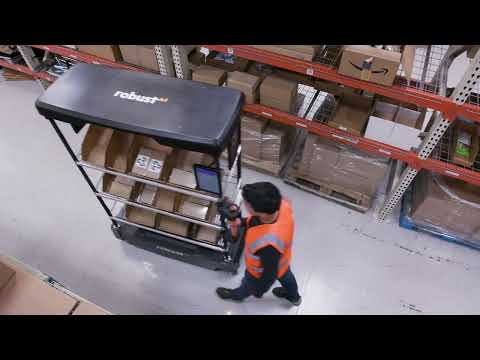
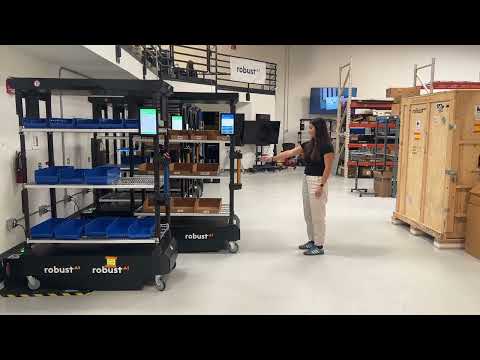
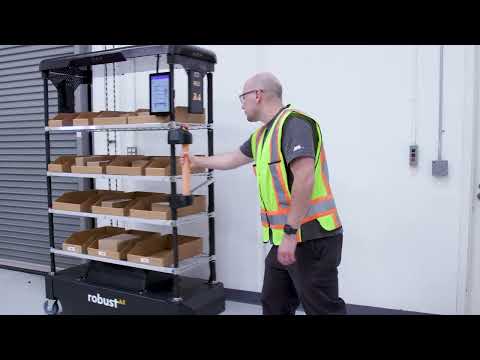
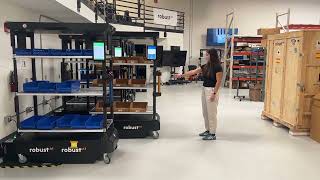
Carter is an autonomous mobile robot, but Robust.AI emphasizes that autonomy is only half of the product. On the [Carter product page](https://www.robust.ai/carter), the company lists a force-sensitive handlebar that allows single-hand operation, whole-robot force sensing for manual manipulation, a patented holonomic drive, adaptive put-to-light LEDs, high-visibility marquees, a touchscreen, and a built-in barcode scanner. These are not decorative interfaces. They define how an associate can understand, redirect, position, load, and confirm work with the machine.
The holonomic drive allows movement in any direction without a conventional turn. That can help Carter align with shelving, stations, or workers in tight spaces. It does not make layout irrelevant. Aisle width, crossing points, forklift traffic, staging, queues, fire routes, blind corners, and pedestrian behaviour still affect performance and safety. A buyer should test representative peak traffic, not an empty demonstration route.
Robust.AI publishes a 100-kilogram, or 220-pound, payload capacity and 18 hours of operating time. The platform dimensions are listed as 0.72 metres wide, 1.4 metres long, and 1.94 metres high. Those figures help with early screening, but the complete application depends on shelf design, load distribution, center of gravity, tote stability, speed, floor condition, ramps, doorways, charging strategy, and the real duty cycle. A payload rating is not a substitute for validating the actual cart configuration.
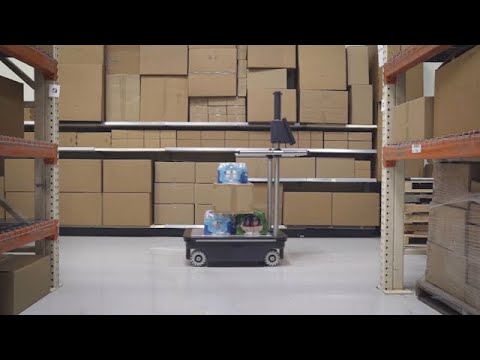
The [warehouse fulfillment page](https://www.robust.ai/warehousefulfillment) identifies four main uses: picking, putaway, point-to-point transport, and sortation. Directed picking uses the robot and software to guide associates between tasks. Point-to-point transport creates a virtual conveyor between stations. Mobile sortation lets teams batch pick and sort onto the robot rather than constructing a fixed sort wall. Putaway applies similar task direction to inbound inventory placement. Each workflow has a different bottleneck, so buyers should not use a single productivity percentage for all of them.
### A second 2026 project introduces a better adoption model
Three weeks before the O'Neill news, Robust.AI [announced a ShipLab deployment](https://www.robust.ai/shiplab-deployment) using what it calls a Crawl, Walk, Run model. The initial phase was planned to automate tote transport between fulfillment and packing stations at ShipLab's Vista, California, facility. If the pilot met agreed targets, the project would expand to a broader Carter fleet across the picking operation.
The most notable part is commercial rather than mechanical. Robust.AI said Robotics-as-a-Service payments would be deferred at each phase until performance targets were jointly confirmed. Its broader messaging describes a performance-based RaaS model in which customers pay once the system is operational and delivering results. This can reduce the capital and adoption barrier, but only if the contract makes the performance test unambiguous.
A sound agreement needs a frozen baseline, defined data sources, an agreed measurement window, minimum volume, expected staffing, product and order exclusions, treatment of unusual downtime, and a method for separating robot impact from other process changes. It should also specify what happens if performance is partly met, delayed by customer readiness, or affected by WMS data. The payment trigger should not rely on a vague promise of productivity.
The phased model is worth copying even when the commercial terms differ. Start with a contained flow that has clear handoffs and enough volume to matter. Validate travel reduction, cycle time, station balance, robot utilization, uptime, exceptions, associate training, and safety. Expand to directed picking only after the transport flow is stable. Then add further workflows or sites using evidence from the earlier phase. This prevents a large fleet from multiplying an unproven process.
### Gen 3 Carter adds radar and vision perception
Robust.AI's product direction also advanced in June through its work with Aptiv. The companies [announced that Gen 3 Carter will use Aptiv PULSE perception](https://www.robust.ai/robustai-selects-aptiv-perception), combining a surround-view camera with ultra-short-range radar. Aptiv's system fuses radar and vision data to support depth maps, occupancy grids, navigation, and functional safety. Robust.AI pairs that with its visual SLAM and perception software.
The practical goal is reliability in real industrial environments. Warehouses and manufacturing floors can include dust, glare, reflective surfaces, moisture changes, cold areas, people, forklifts, racks, and temporary obstructions. Camera and radar signals have different strengths, so combining them can reduce some perception weaknesses. Robust.AI also said the work establishes a foundation for Performance Level d certification across relevant industrial safety uses, while Aptiv is advancing toward that certification for PULSE.
The wording matters. A foundation or path toward certification is not the same as a currently certified complete deployment. Buyers should request the exact safety architecture, product version, certificates, scope, assumptions, exclusions, and validation requirements that apply to their proposed fleet. They should also ask whether the quoted robot is Gen 3, which sensing configuration it includes, and when that configuration is available for production use.
This is particularly relevant to Carter because direct collaboration is central to the product. A robot designed to share close space with people must communicate intent clearly and respond predictably when conditions change. Sensors are one layer. Site risk assessment, speed and separation settings, floor markings, training, right-of-way rules, emergency stops, maintenance procedures, and incident review remain essential.
### How the latest deployment fits Carter's commercial record
The O'Neill and ShipLab announcements add to an existing group of logistics projects. Robust.AI previously announced a five-year strategic alliance with DHL Supply Chain, including 15 Carter units in Mexico and a plan that could reach hundreds across the Americas. The DHL release reported productivity improvements above 60% in North American operations and 30% in Mexico at that time. Those are first-party and partner-reported figures, so a prospective buyer should ask for metric definitions and comparable workflow data before placing them in a business case.
At Saddle Creek, Carter was deployed as a flexible virtual conveyor between processing and labeling lines and more than 20 drop-off points. The case description reported less walking, greater tote capacity per trip, operator-directed actions, more balanced work, and less congestion. This is a useful example because it shows a narrower application that can produce value without deep WMS integration. It also illustrates why point-to-point transport is often a good first phase: the flow is visible, travel can be measured, and the stations at both ends can be observed directly.
The commercial record is developing across both simple and integrated uses. Buyers should separate three categories when checking references: non-integrated transport, system-directed picking, and mobile sortation. A successful tote shuttle does not automatically prove WMS-directed picking, just as a productive picking workflow does not prove every sortation configuration. Ask for a reference using the same application, order profile, and operational constraints.
### What warehouse operators should validate before scaling
The correct pilot metric is not how many robots are on the floor. It is how much completed, accurate work the operation produces with each robot and each labor hour. Track units, orders, or totes completed; associate travel; station wait; robot wait; touches; exceptions; accuracy; congestion; downtime; charging; interventions; and service level. Measure worker adoption too. Associates who do not trust task instructions or find handoff awkward may work around the system, masking problems until peak.
Integration needs similar discipline. For directed work, document item, location, inventory, order, task, scan, confirmation, cancellation, priority, and exception events. Define which system owns each state and how discrepancies are reconciled. Test poor Wi-Fi, delayed messages, duplicate scans, unavailable locations, short picks, full totes, cancelled orders, blocked routes, and station outages. A normal-path demo is not an acceptance test.
Commercially, request the full RaaS model. Confirm the minimum term, fleet size, included software, maintenance, batteries, replacement equipment, support hours, response times, travel, training, upgrades, relocation, insurance, damage, cybersecurity, data access, and exit obligations. If payments depend on performance, attach the metric schedule to the agreement rather than leaving it in a presentation.
The latest O'Neill deployment strengthens Carter's case as a flexible 3PL automation platform, while ShipLab's phased model offers a sensible way to adopt it and the Gen 3 perception work shows where the hardware is heading. The opportunity is credible: reduce travel and material-handling friction without committing to fixed infrastructure. The safest decision is still evidence-led. Begin with a real bottleneck, define success precisely, prove the workflow under peak and degraded conditions, and scale only when the operation, workforce, safety case, and contract all support the next phase.
Robust.AI Carter is a collaborative autonomous mobile robot built for picking, putaway, point-to-point transport, value-added services, and mobile sortation. It combines autonomous navigation with direct physical and visual interaction for warehouse associates.
How Carter Supports Warehouse Picking and Transport
Carter includes a force-sensitive handlebar, whole-robot force sensing, holonomic movement, 360-degree vision, visual SLAM, adaptive LEDs, a touchscreen, a barcode scanner, and configurable shelving. The same fleet can be reassigned across several software-defined workflows.
Who Should Evaluate Carter?
Carter is best evaluated through a measured pilot in a travel-heavy process. Buyers should validate safety, integration, robot utilization, completed work, labor productivity, congestion, exception handling, worker adoption, commercial triggers, and support before scaling.
About Robust.AI Carter
Robust.AI Carter is a collaborative autonomous mobile robot for warehouse and manufacturing material movement. It combines autonomous navigation with a force-sensitive handlebar, whole-robot force sensing, holonomic movement, adaptive put-to-light LEDs, a touchscreen, a barcode scanner, and configurable shelving. The same software-defined fleet can support directed order picking, putaway, point-to-point tote transport, value-added services, and mobile sortation. Robust.AI offers performance-based Robotics-as-a-Service deployments designed to start with a defined workflow and scale after jointly agreed results are demonstrated.
Use Cases
Key Features
- ✓ Autonomous warehouse navigation
- ✓ 360-degree AI-optimized vision
- ✓ Camera-based visual SLAM
- ✓ Patented holonomic drive
- ✓ Force-sensitive handlebar
- ✓ Whole-robot force sensing
- ✓ Adaptive put-to-light LEDs
- ✓ High-visibility instruction marquees
- ✓ Integrated touchscreen interface
- ✓ Built-in barcode scanner
- ✓ Configurable shelving options
- ✓ System-directed order picking
- ✓ Point-to-point transport
- ✓ Mobile sortation
- ✓ Putaway workflow support
Pricing
Performance-Based RaaS
Custom quote
- • All-inclusive commercial model
- • Payments tied to agreed performance
- • Deployment, software, and support terms
Pilot Deployment
Custom quote
- • Defined initial workflow and fleet
- • Baseline and acceptance metrics
- • Training and operational validation
Fleet Expansion
Custom quote
- • Additional robots and workflows
- • Multi-site scaling
- • Integration and optimization support
Pricing varies by plan and region — see current pricing.
Plan features change — last updated: 2026-08-16.
Details
Tags
Robust.AI Carter Community Discussions
Explore community discussions. Ask and answer questions on Robust.AI Carter to grow and learn together.
Robust.AI Carter Showcase
Robust.AI Carter — Frequently Asked Questions
What is Robust.AI Carter?
Carter is a collaborative autonomous mobile robot designed to work around and directly with warehouse associates. It can navigate autonomously, accept physical guidance through its handlebar, display instructions, scan barcodes, and carry configurable shelving for several material-handling workflows.
Which workflows can Carter support?
Robust.AI markets Carter for system-directed picking, putaway, point-to-point transport, value-added services, and mobile sortation. The software-defined platform can switch functions without requiring a different robot for each workflow.
What are Carter's published specifications?
Robust.AI lists exterior dimensions of 0.72 by 1.4 by 1.94 metres, a payload capacity of 100 kilograms or 220 pounds, 18 hours of operating time, and a 360-degree camera field of view. Buyers should confirm current configuration and site-specific limits in a proposal.
Does Carter require fixed infrastructure?
Robust.AI positions Carter as drop-in automation that does not require new conveyor infrastructure. A deployment still needs safe routes, charging, network coverage, workflow design, operational controls, and integration or dispatch logic appropriate to the site.
How much does Carter cost?
Robust.AI does not publish standard prices. Its current commercial messaging emphasizes an all-inclusive, performance-based Robotics-as-a-Service model with custom terms. Buyers should request fleet, deployment, integration, support, metric, and scaling details in writing.
How should a Carter pilot be measured?
Use a pre-agreed baseline and measure completed work, travel distance, touches, cycle time, units per labor hour, robot utilization, congestion, exceptions, downtime, safety events, training time, and worker adoption. Include peak and degraded conditions, not only average shifts.
Sources & References
Try Robust.AI Carter
Visit the official website to get started with Robust.AI Carter today.
Visit Robust.AI Carter →